


Artificial Intelligence
Pursuing computing advances to create intelligent machines that complement human reasoning to augment and enrich our experience and competencies.


Video
Guiding the AI disruption to the Good Place
The true impact of AI does not lie in how well it takes tests or surfs the web, but in how effectively it teaches, coordinates, and operates in a web built for agents rather than…

Video
New fine-tuning of language models: Match meaning, not tokens
Language models are usually trained to predict the next word, but that does not always lead to the best overall answers. We introduce energy-based fine-tuning, a new method that trains models to produce better full…

Video
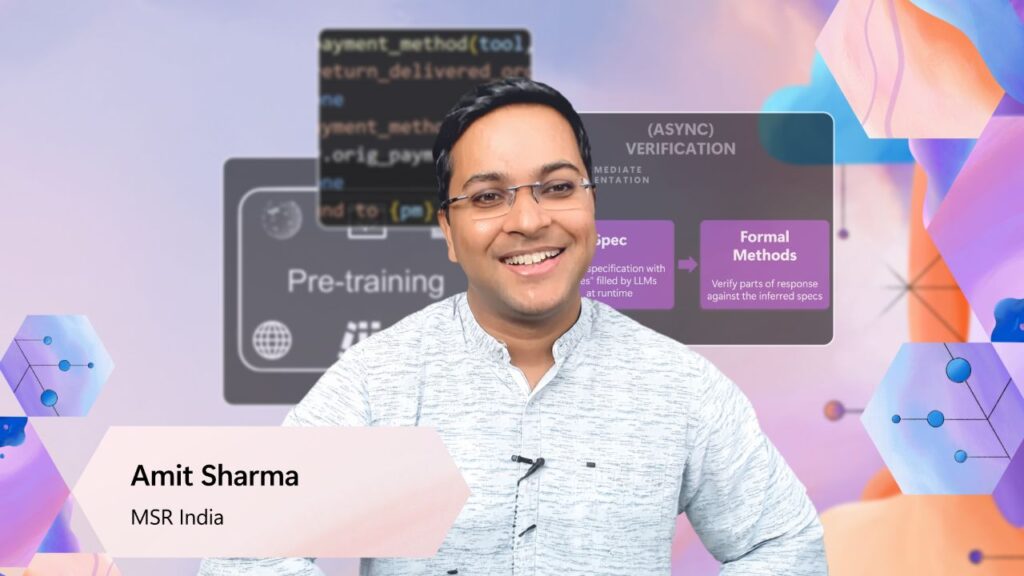
Introducing Interwhen: Steering reasoning agents with real-time verification
What if AI agents could check their work as they go? This verification method extracts verifiable properties from natural language and evaluates them using symbolic or model-based verifiers. Interwhen, a new open-source library, enables real-time…
Video
Introducing GitHub Agentic Workflows: AI that runs your repo
What if your repo could run itself? GitHub Agentic Workflows bring AI agents directly into repository automation, enabling tasks to run end-to-end inside GitHub Actions. With built-in guardrails and Microsoft-hosted models on Azure, this system…

Video
MagenticLite: A full-stack agentic experience powered by Small Models
What if you could run a capable AI agent without leaning on frontier-scale models? MagenticLite is the next generation of Magentic-UI, an agentic experience reimagined and optimized for small language models. It works across both…

Project
Project Volano
Enabling everyone to shape AI Project Volano is carrying out cross-disciplinary research to understand how we can value and utilize community perspectives throughout the whole of the AI pipeline. Our first use case is to…
Career Opportunity
Cambridge Internship: Novel Light Source Design
The Future AI Infrastructure team at Microsoft Research Cambridge (UK) is pioneering scalable, energy-efficient optical technologies to redefine the future of data centre infrastructure. We’re looking for a talented, curious and motivated PhD student to…
Microsoft Research Blog
GridSFM: A new, small foundation model for the electric grid
Introducing GridSFM, a small foundation model that can predict AC optimal power flow in milliseconds, boosting efficiency and unlocking cost savings. Learn how GridSFM gives grid operators direct visibility into congestion, stability, and system health.

Tool
GridSFM | Small Foundation Models for the Power Grid
GridSFM is an open-source framework for neural surrogate modeling of AC Optimal Power Flow (AC-OPF) on realistic approximations of the US power grids, derived exclusively from open data.
Microsoft Research Blog
Advancing AI for materials with MatterSim: experimental synthesis, faster simulation, and multi-task models
MatterSim is expanding what AI can do for materials science—from faster large-scale simulations to MatterSim-MT, a new multi-task model for simulating properties beyond potential energy surfaces alone.
