

Skip to main content Why Microsoft Security AI-powered cybersecurity Cloud security Data security & governance Identity & network access Privacy & risk management Security for AI Unified SecOps Zero Trust Microsoft Defender Microsoft Entra Microsoft Intune Microsoft Priva Microsoft Purview Microsoft Sentinel Microsoft Security Copilot Microsoft Entra ID (Azure Active Directory) Microsoft Entra Agent ID Microsoft Entra External ID Microsoft Entra ID Governance Microsoft Entra ID Protection Microsoft Entra Internet Access Microsoft Entra Private Access Microsoft Entra Permissions Management Microsoft Entra Verified ID Microsoft Entra Workload ID Microsoft Entra Domain Services Azure Key Vault Microsoft Sentinel Microsoft Defender for Cloud Microsoft Defender XDR Microsoft Defender for Endpoint Microsoft Defender for Office 365 Microsoft Defender for Identity Microsoft Defender for Cloud Apps Microsoft Security Exposure Management Microsoft Defender Vulnerability Management Microsoft Defender Threat Intelligence Microsoft Defender Suite for Business Premium Microsoft Defender for Cloud Microsoft Defender Cloud Security Posture Mgmt Microsoft Defender External Attack Surface Management Azure Firewall Azure Web App Firewall Azure DDoS Protection GitHub Advanced Security Microsoft Defender for Endpoint Microsoft Defender XDR Microsoft Defender for Business Microsoft Intune core capabilities Microsoft Defender for IoT Microsoft Defender Vulnerability Management Microsoft Intune Advanced Analytics Microsoft Intune Endpoint Privilege Management Microsoft Intune Enterprise Application Management Microsoft Intune Remote Help Microsoft Cloud PKI Microsoft Purview Communication Compliance Microsoft Purview Compliance Manager Microsoft Purview Data Lifecycle Management Microsoft Purview eDiscovery Microsoft Purview Audit Microsoft Priva Risk Management Microsoft Priva Subject Rights Requests Microsoft Purview Data Governance Microsoft Purview Suite for Business Premium Microsoft Purview data security capabilities Pricing Services Partners Cybersecurity awareness Customer stories Security 101 Product trials How we protect Microsoft Industry recognition Microsoft Security Insider Microsoft Digital Defense Report Security Response Center Microsoft Security Blog Microsoft Security Events Microsoft Tech Community Documentation Technical Content Library Training & certifications Compliance Program for Microsoft Cloud Microsoft Trust Center Security Engineering Portal Service Trust Portal Microsoft Secure Future Initiative Business Solutions Hub Contact Sales Start free trial Microsoft Security Azure Dynamics 365 Microsoft 365 Microsoft Teams Windows 365 Microsoft AI Azure Space Mixed reality Microsoft HoloLens Microsoft Viva Quantum computing Sustainability Education Automotive Financial services Government Healthcare Manufacturing Retail Find a partner Become a partner Partner Network Microsoft Marketplace Marketplace Rewards Software development companies Blog Microsoft Advertising Developer Center Documentation Events Licensing Microsoft Learn Microsoft Research View Sitemap

Putting Information Sharing into Context: New Whitepaper Offers Framework for Risk Reduction

The nearly incessant drumbeat of cybersecurity incidents over the past weeks and months has brought about renewed interested in information sharing across the technical and political spheres. For example, earlier this month the White House proposed legislation to encourage information sharing which President Obama also referred to in his State of the Union address. When it comes to cybersecurity, the right information exchanged or shared at the right time can enable security professionals and decision makers to reduce risks, deflect attacks, mitigate exploits and enhance resiliency. In this case, forewarned really can mean forearmed.

Information sharing is not a novel idea. A number of initiatives around the world have been in place and working successfully for some time. For example, here at Microsoft we have a program in place that gives security software providers early access to vulnerability information so that they can provide updated protections to customers faster. From this and other programs of various sizes we have learned that despite the increased focus on collective action from both private practitioners and policy makers around the world, effective information sharing is not an easy undertaking. It requires clear definitions and objectives rather than solely words of encouragement, or mandatory requirements. Furthermore, it is all too often viewed simply as a goal in and of itself rather than as a mechanism for improving security, cybersecurity assessment, and risk management. Finally, and from the public-private partnership perspective most pressingly, information sharing can quickly expand into controversies involving originator control, trust, transparency, privacy and liability.

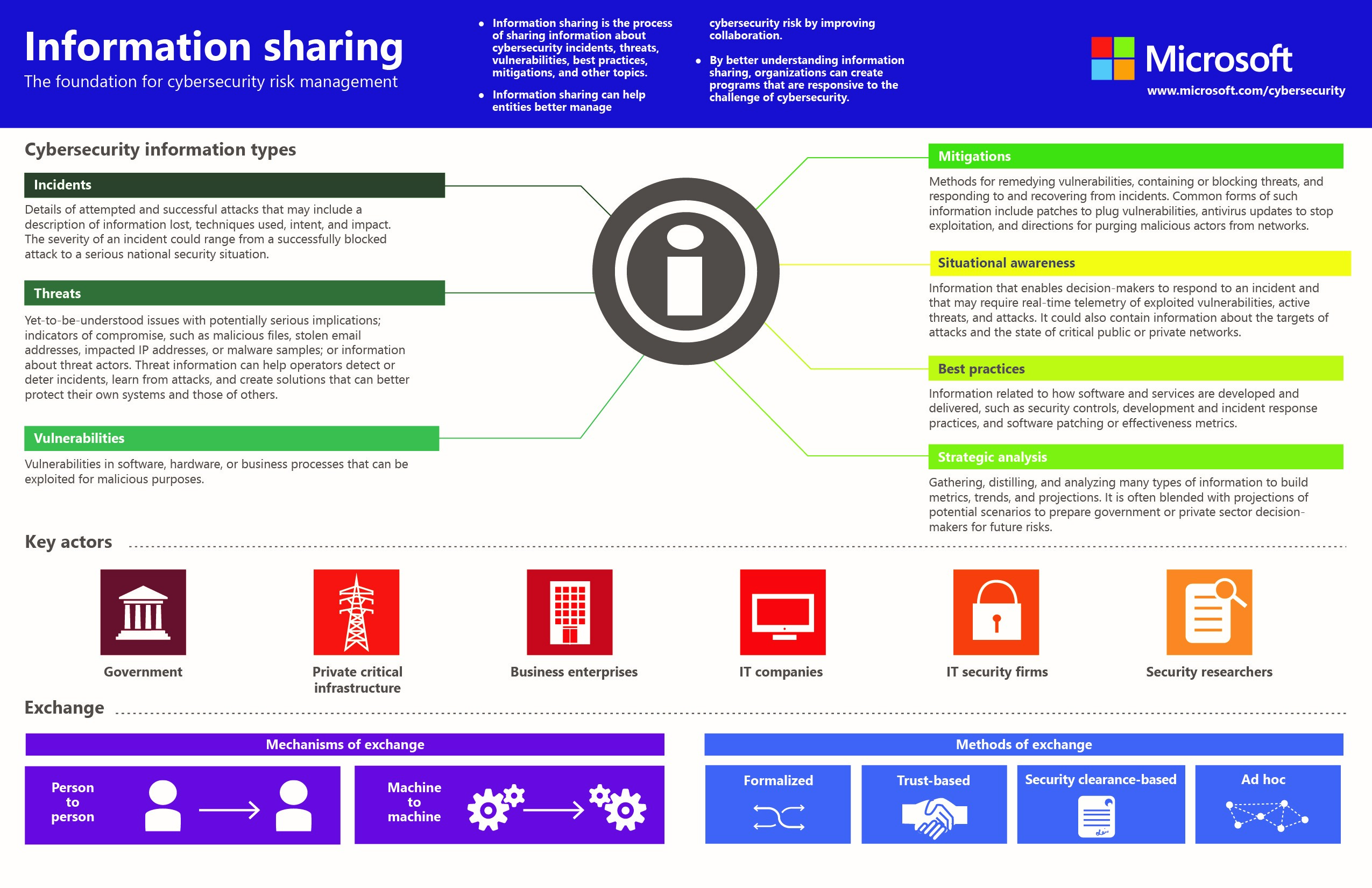
To help put this complex issue into context, today we are releasing a new white paper: A framework for cybersecurity information sharing and risk reduction. Leveraging Microsoft’s decades of experience in managing security for our products, infrastructure, and customers, the paper provides a taxonomy for information exchanges including types, actors, and methods. We believe that understanding how to incentivize information sharing and how to better harness the practice for risk reduction can help move policy and strategy debates forward and support better defence of cyber assets and infrastructure. The paper concludes with a discussion of best practices and seeks to lay the groundwork for a more formalized, collaborative approach to information sharing and implementing exchanges through a set of recommendations. I hope that it can serve as a relevant and timely guide for anyone with responsibility for developing new ideas and solutions for information exchanges.

Information Sharing Infographic

Related posts