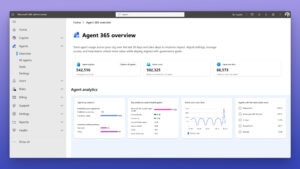
A how-to guide for governing, implementing, adopting, supporting, and measuring the impact of AI agents from Microsoft Digital, the company’s IT organization.
The agentic future: Our journey to becoming a Frontier Firm at Microsoft
A new way of working, a modern way to achieve more
The rate of change for AI tools and technology continues to accelerate, and new opportunities to reimagine business processes and employees’ day-to-day workflows are emerging. Agents are the driving force behind this next leap forward.
As a result of this technological shift, a new organizational blueprint is emerging. It blends machine intelligence with human judgment to create systems that are AI-operated but human-led.
We have a name for an organization that enacts this model: The Frontier Firm.
As organizations progress toward this goal, they move from foundational AI assistance through escalating levels of agentic maturity and complexity. First, humans operate with help from an AI assistant like Microsoft 365 Copilot. Then, human-agent teams work together. But the future lies in humans leading teams of agent users: AI agents that perform core labor with relative autonomy.
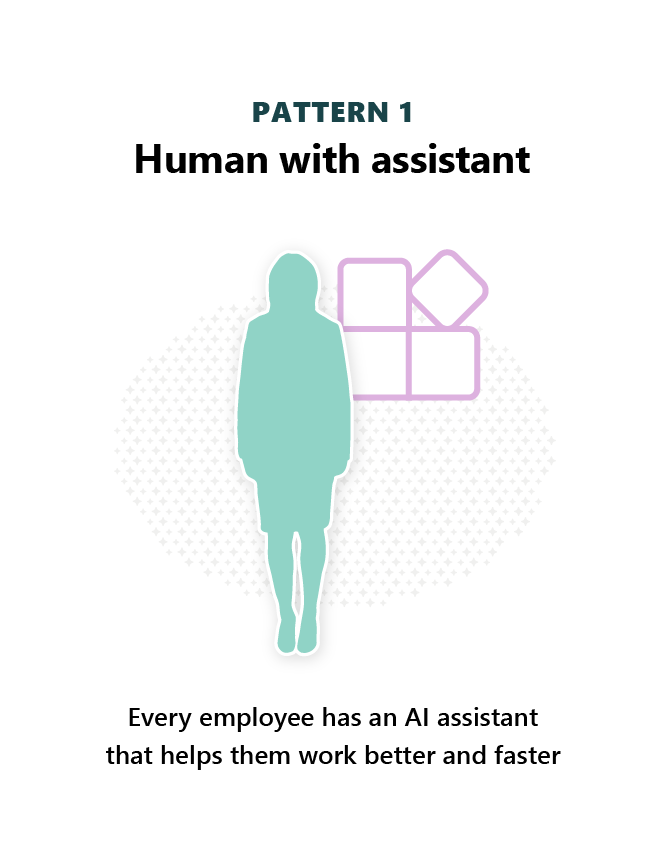
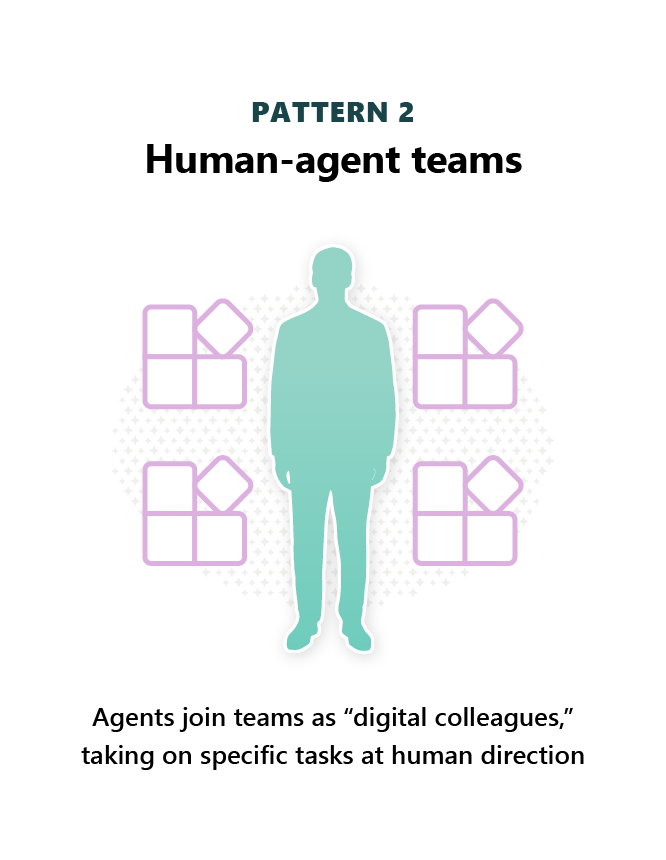
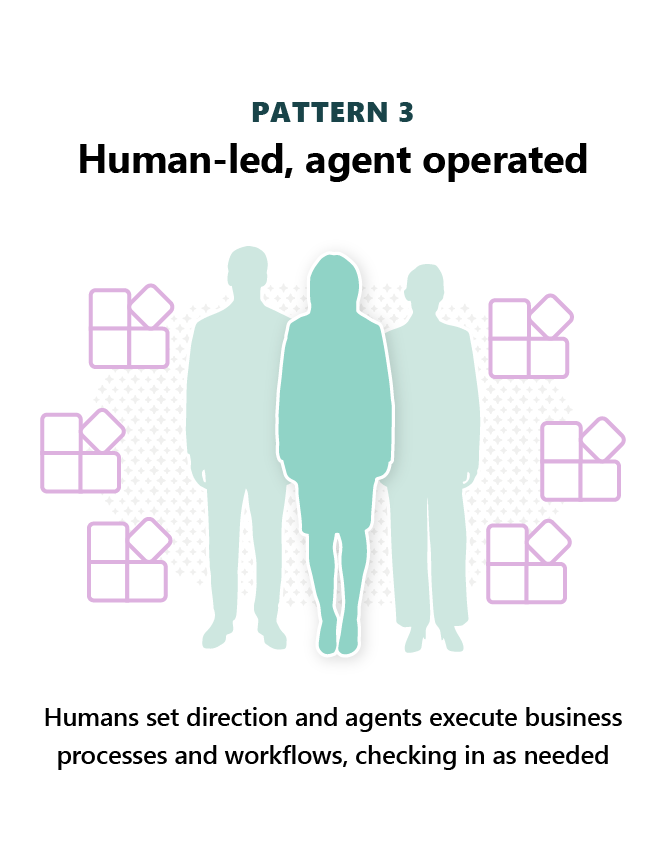
This has been a three-year process for us at Microsoft, and throughout our journey, we’ve had to allow adequate time for deliberate planning and careful execution. Just as importantly, we invested early in clear, consistent internal communications to help employees understand what agents are, why they matter, and how they could safely participate in building them. That shared understanding created the confidence and momentum required to scale agent creation across a global workforce.
“It’s a truly transformative time,” Brian Fielder, vice president of Microsoft Digital. “What we’ve learned from embracing the agentic future at Microsoft is only making us more eager to see organizations empower their employees to take the lead in a world where human judgment and machine intelligence work in harmony.”
Our Frontier Firm journey so far
Within Microsoft Digital, the company’s IT organization, we’re taking a leadership role in reimagining core processes and workflows. These efforts rest on four pillars of practice:
- We envision and implement the AI-first workplace of the future.
- We empower our employees to build their own agents that help supercharge their productivity by providing the training, resources, and inspiration they need.
- We define guardrails and safeguard our environment so our employees can maximize the power of AI while keeping our enterprise safe and secure.
- We’re the voice of company’s internal AI transformation, and we provide the blueprint for our customers to accelerate their own AI journeys.
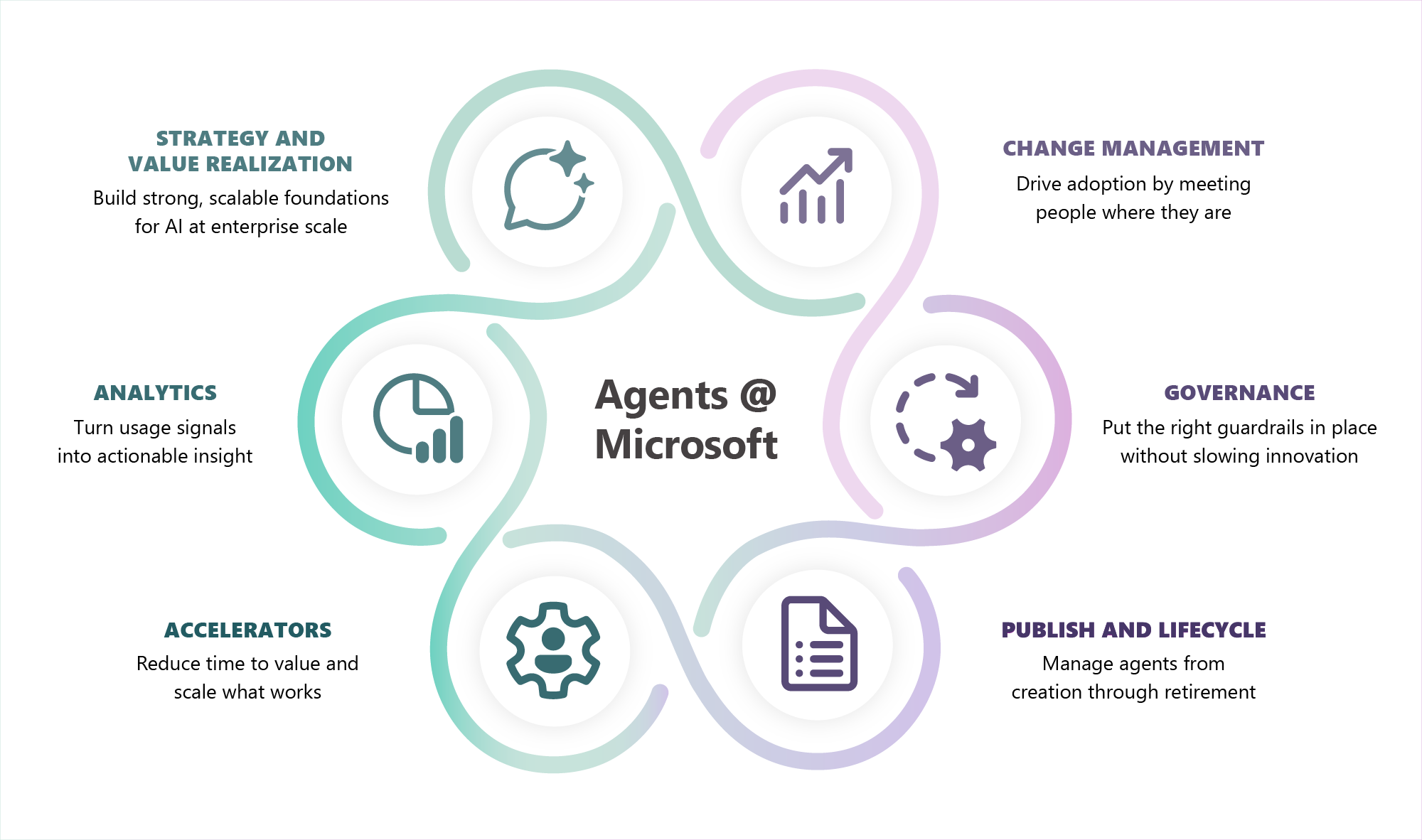
To guide our steps, we’ve established a cross-disciplinary initiative we call Agents at Microsoft. We’re looking at agentic transformation from an end-to-end perspective that reaches into every aspect of building, publishing, governing, managing, and getting the most value out of agents.
As we’ve incorporated agents into more and more aspects of our organization, key questions have surfaced:
- How do we balance freedom for employees to create agents against the need to manage sprawl?
- How do we put guardrails around agentic capabilities so they can be useful, without introducing undue risks?
- How do we differentiate between agents of different complexity and capability, and how do we adjust our strategies around them accordingly?
- Where can we use agents to fill enterprise functions, and who should be responsible for creating those crucial tools?
- How can we adapt existing software development standards to AI tools?
- How can we minimize the risk of data over-exposure through AI?
It’s possible you’re also considering where agents fit into your organization. If so, it’s likely that you’re wrestling with many of the same questions. We’re here to help.
This guide shares our experience as Customer Zero for agents at Microsoft. As you read, you’ll be able to follow our journey to defining what it means to govern agents safely, implement them effectively, guide their adoption by employees, build a foundation for support, and track their impact through effective measurement.
We’ll share some of the most important lessons we’ve learned so far, along with readiness checklists and resources that can help you advance agentic maturity at your organization. With this guide in your toolkit, you’ll have a framework for building a strategy that incorporates agents into your business goals safely, responsibly, empathetically, and impactfully.
“As we harness the transformative power of AI agents, it’s our responsibility in IT to ensure that technology not only enhances decision making but also fosters a culture of innovation and collaboration across the organization,” says Stephan Kerametlian, a business program management senior director in Microsoft Digital.
The agentic future is here. We’ve explored the path forward, and we’ve seen the exciting places it leads. This guide can help you take your first steps and start realizing those possibilities today.
Expert insights

“It’s a truly transformative time. What we’ve learned from embracing the agentic future at Microsoft is only making us more eager to see organizations empower their employees to take the lead in a world where human judgment and machine intelligence work in harmony.”
Brian Fielder, vice president, Microsoft Digital

“As we harness the transformative power of AI agents, it’s our responsibility in IT to ensure that technology not only enhances decision-making but also fosters a culture of innovation and collaboration across the organization.”
Stephan Kerametlian, business program management senior director, Microsoft Digital
Chapter 1: Advancing good governance to meet the agentic moment
Maintaining privacy, security, and compliance while respecting regulatory frameworks
Agents offer powerful opportunities to enhance employee productivity, but they also introduce concerns. For example, how do we keep privileged information where it belongs? And how do we keep employees from building agents that violate company policies?
In answering these questions, Microsoft Digital’s governance team focused on the value the company is trying to derive from agents.
We wanted to give employees and teams the freedom to build without risk to the business or introducing agent duplication and sprawl. We wanted to weave robust, reliable agentic experiences into enterprise workflows. We also needed to secure and protect confidential data while respecting responsible AI principles.
“Our principles haven’t changed, but they’ve evolved,” says David Johnson, a tenant and compliance architect at Microsoft Digital. “With AI, the need for proactive governance is far greater than ever before, so we’re putting structures in place that take some of the labor around managing agents off of IT.”
There are some cornerstone constructs that underpin our agent governance strategy. There’s a tenant that holds employees accountable, a reasonably clean data estate, a lifecycle for the agents users-they disappear when the employee leaves.
We’ve developed six core principles to guide our approach to governing agents:
- We ensure a strong data hygiene foundation so we can trust our data estate as employees build and use agents.
- We empower employees to build personal agents that can access services and data sources those users can already access to help automate and accelerate their tasks.
- We empower teams and lines of business to build agents with known lower risk patterns to accelerate impact.
- We provide a smooth release path for engineering teams to develop agents designed for enterprise functions so they can access all of the services and sources they need.
- We accelerate innovation through agent and automation templates while maintaining an AI Center of Excellence (CoE) to help teams think through their opportunities.
- We reimagine employee experiences and task execution to simplify and optimize productivity.
As a result of our experience establishing strong governance for Microsoft 365 Copilot, we’d already laid a firm foundation for an agent-ready data estate. In some ways, governance is tool-agnostic, rooted in basic principles. With appropriate data labeling, data hygiene, and well-managed permissions in place alongside tools that respect labels by default, we can confidently give every employee the ability to build basic agents and trust in our governance guardrails.
A matrixed approach to agent governance
The sheer diversity of agents and their use cases means we need a multifaceted approach to governance. A matrix of different parameters applies to any agent, and each of those elements requires its own approach to policy.
In practice, agent governance structures echo our overall maturity approach. Simple, personal, lower-risk agents with built-in guardrails act as a starting point for employee experimentation and require very little oversight. As a result of our robust data hygiene foundation, if an employee has access to the grounding content, these agents are low-risk accelerators for things they can already do on their own. Meanwhile, higher-impact agents demand greater attention that echoes our security development lifecycle (SDLC) for internal apps, which include more extensive, cross-disciplinary reviews.
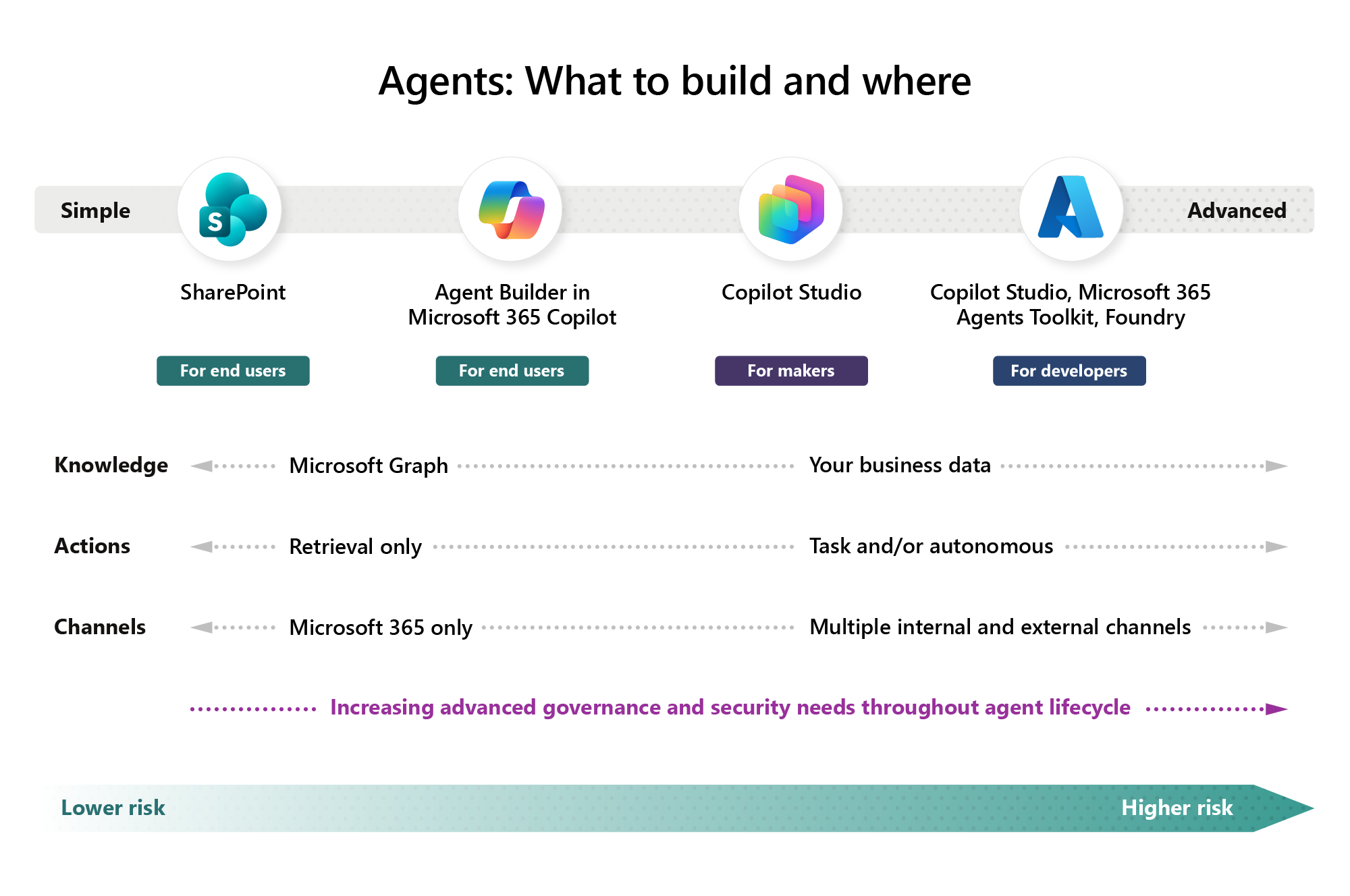
To accommodate agent-creation experiences across this spectrum, we’ve enabled several different building platforms and processes employees and teams can use to create the AI tools they need.
- We opened up Agent Builder in Microsoft 365 Copilot for all employees to create read-only declarative agents.
- We created an environment strategy and governance in Power Platform to manage personal environments featuring data connectors with lower risk but high value.
- We enabled a process to flow the data that teams need into production Power Platform environments featuring data connectors. These agents initially come with sharing limits until the agent receives risk approval.
This structure provides the ability to safely create agents of increasing complexity while ensuring they remain secure and contained until they get the necessary reviews for wider sharing and data exposure.
Our governance guardrails, review policies, and publishing scope varies based on the tool used to create an agent, the level of technical proficiency it requires, its grounding in knowledge sources, its capabilities, the actions it can take, the plug-ins it requires, and whether it includes a custom engine or a bring-your-own model.
The following examples illustrate two different agent scenarios:
An employee builds a knowledge-only agent using Agent Builder in Microsoft 365 Copilot.
This agent features graph connectors from a pre-approved catalog for exposing additional data, easily created using no-code tools. Its knowledge sources are limited to SharePoint and OneDrive sites accessible to the employee, along with external websites, custom instructions, and additional internal sources through graph connectors. As a result, the risk of data overexposure is limited. These agents can’t take action, they don’t rely on plug-ins, and they’re tied to our data hygiene foundation. The employee can only use the agent personally or share it through a link.
No review necessary: Our team in Microsoft Digital honors reactive take-down requests like any other self-service construct, but does not provide proactive gating.
Professional developers build an agent to manage enterprise workflows.
Agents created using pro-code tools can include custom connectors and orchestration logic to handle more complex scenarios, and their builders typically intend them to become Microsoft Teams apps or part of our agent catalog for wide organizational use. Their knowledge sources can be almost anything, from internal SharePoint sites to third-party apps, so they’ll often need to make use of APIs. For these apps, knowledgeable builders can create custom Azure OpenAI large language models (LLMs).
Reviews: These agents require reviews for security, privacy, accessibility, responsible AI, and an environment-specific maker stack review. This review stage is essential because these agents can potentially transform or write data outside their places of origin. These capabilities represent both the power of agents and the risk we need to evaluate.
As you consider your own governance structures and policies, think about where agents and the ability to create them fit your needs and risk tolerance. Then learn from the different parameters of our governance matrix to access a working model for your own agentic transformation.
Expert insights

“Our principles haven’t changed, but they’ve evolved. With AI, the need for proactive governance is far greater than ever before, so we’re putting structures in place that take some of the labor around managing agents off of IT.”
David Johnson, tenant and compliance architect, Microsoft Digital

As you consider your own governance structures and policies, think about where agents and the ability to create them fit your needs and risk tolerance. Then learn from the different parameters of our governance matrix to access a working model for your own agentic transformation.
Aisha Hasan, Power Platform and Copilot Studio product manager, Microsoft Digital
Balancing utility and manageability in our agent ecosystem
Empowering employees and teams to simply and securely create agents has been a top priority as we move toward AI maturity at Microsoft, but we also want to eliminate agent sprawl.
Aside from complicating agent management, sprawl has several user-side disadvantages. For example, if more than one team were to create an agent that points to HR information, the employee experience would suffer, because our users wouldn’t be sure which agent serves as the authoritative source of truth.
Our team in Microsoft Digital partners with other internal organizations to ensure we’re prioritizing the right agent development projects and avoiding agent sprawl. Ideally, these engagements take place before teams start building their agents so we can avoid wasted effort or duplicate work.
If a pre-existing agent fits the target scenario, we encourage a team to use that agent instead of creating a redundant solution. For employees who want to create their own agents, we recommend that they first search for an existing tool in our agent catalog to avoid duplication.
User-based lifecycles and periodic attestation are also key pieces of the puzzle. Requiring attestation helps ensure that agents cease to exist once they’re no longer useful or their owner leaves the company.
The release of Microsoft Agent 365, now in early access, represents the next step forward in agent observability and management, two key aspects of agent governance and sprawl mitigation. This control pane for agents incorporates many of Microsoft’s Digital’s learnings as we’ve bridged governance gaps through IT intervention.
- The registry provides a complete view of agents. The enterprise agent store makes it easy to find the right agents for each role and business process within familiar workflows in Microsoft 365 Copilot and Teams.
- Visualization provides the observability layer, including role-specific oversight, compliance and audit features, and performance measurement that can help organizations track their agents’ impact and see where they contribute value.
- Interoperability ensures Agent 365 is open to any Microsoft-built or partner ecosystem, while also delivering work intelligence through access to data and Microsoft 365 apps.
- Security features provide crucial confidence through visibility into security posture, detection and response capabilities, and intelligent runtime defense.
“The next step in our governance journey will be using AI to help us govern AI,” says Aisha Hasan, Power Platform and Copilot Studio product manager at Microsoft Digital. “We’re looking at ways AI can help us manage this new space, and we believe Agent 365 will be the foundation for our deterministic approach to governance.”
As you strategize to deepen AI maturity at your organization, our experience will help you operationalize many of the aspects of governance we’ve pioneered as Customer Zero for agentic AI, especially with the wide release of Agent 365. By adopting the principles we’ve illustrated in this chapter, you can accelerate your transformation and advance your maturity rapidly and securely.
Learning from our experience with agent governance

A strong data foundation is crucial
We’ve built respect for labeling and data governance policies into the tooling for AI assistants and agents, but it’s dependent on a well-governed data estate. Invest time and effort in establishing that foundation.

Decide on your comfort level with risk
Bring cross-disciplinary experts together from across your organization to determine what level of risk is acceptable for different agents and their use cases. Put guardrails in place for low-risk scenarios and establish processes for supporting more complex or sensitive use cases. Evaluate what data sources agents can extract information from. Do you have confidence that users haven’t over-shared data access?

Agents aren’t always like applications—adjust your processes accordingly
We quickly learned that reasonable processes, approvals, and workflows for internal application development didn’t scale well with agents. Consider a risk-based assessment model.

Change is constant
Plan to reassess and revise your governance structure regularly. This technology is evolving rapidly, as is the tooling surrounding it, so maintaining good governance will be an ongoing practice.

Governance is a value driver for employees
Governance isn’t just about protecting your organization. It also provides the right patterns to make sure your employees are getting value from agentic technology. Establish strong measures of value and a robust pane for management and assessment. Observability and telemetry will be foundational, so ensure you build that into your governance efforts.

Continue non-agentic workstreams
Enterprise technology environments are additive and incremental. Don’t cease your efforts to create and govern other internal technologies. Instead, maintain a holistic ecosystem.

Key takeaways
Use these tips based on what we learned here at Microsoft to tackle agent governance at your company:
- Establish a cross-disciplinary agent center of excellence: Bring together stakeholders across the organization to define priorities, goals, and shared practices for agent adoption.
- Put strong data and information protection policies in place: Establish clear governance for your data estate, including labeling and information protection, to support responsible agent use.
- Right-size oversight based on risk: Determine your organization’s risk tolerance and define which agents require more or less involvement from IT, security, and compliance teams.
- Define a clear agent building tool strategy: Decide which tools employees and teams can use to create agents, balancing empowerment with governance.
- Operationalize agent oversight and management: Establish an oversight model and implement tools like Agent 365 that help manage agents at scale.
- Create a centralized governance and information hub: Provide employees and agent builders with a single place to find guidance, standards, and governance information.

Learn more
How we did it at Microsoft
- Explore our IT playbook for the AI era and learn how we’re becoming a Frontier Firm. This article shares our journey as an IT organization in support of this new operating model.
- Read our five-step guide for IT leaders who want to drive greater AI maturity. This resource can help you chart a course through AI maturity to reimagine what’s possible for the enterprise.
- Discover how Microsoft is becoming an AI-first Frontier Firm. This story shares how we’re approaching the idea of an “agentic future.”
- Learn from our experience tackling Microsoft 365 Copilot governance. This article explains the foundation of our governance efforts in the AI space and can serve as a starting point for agentic governance.
- Discover our six dimensions of agent value. They provide our framework for measuring the impact of AI at Microsoft.
Further guidance for you
- Secure your agents at scale with Microsoft Agent 365 guidance for unified identity, compliance, and control across platforms.
- Find out more about security and governance in Microsoft Copilot Studio with our product‑level guidance on DLP, environment controls, audit logs, and security features specific to Copilot Studio agents.
Chapter 2: The Microsoft roadmap for implementing agents
Developing a plan to advance AI maturity while unlocking agentic value at every level of our organization
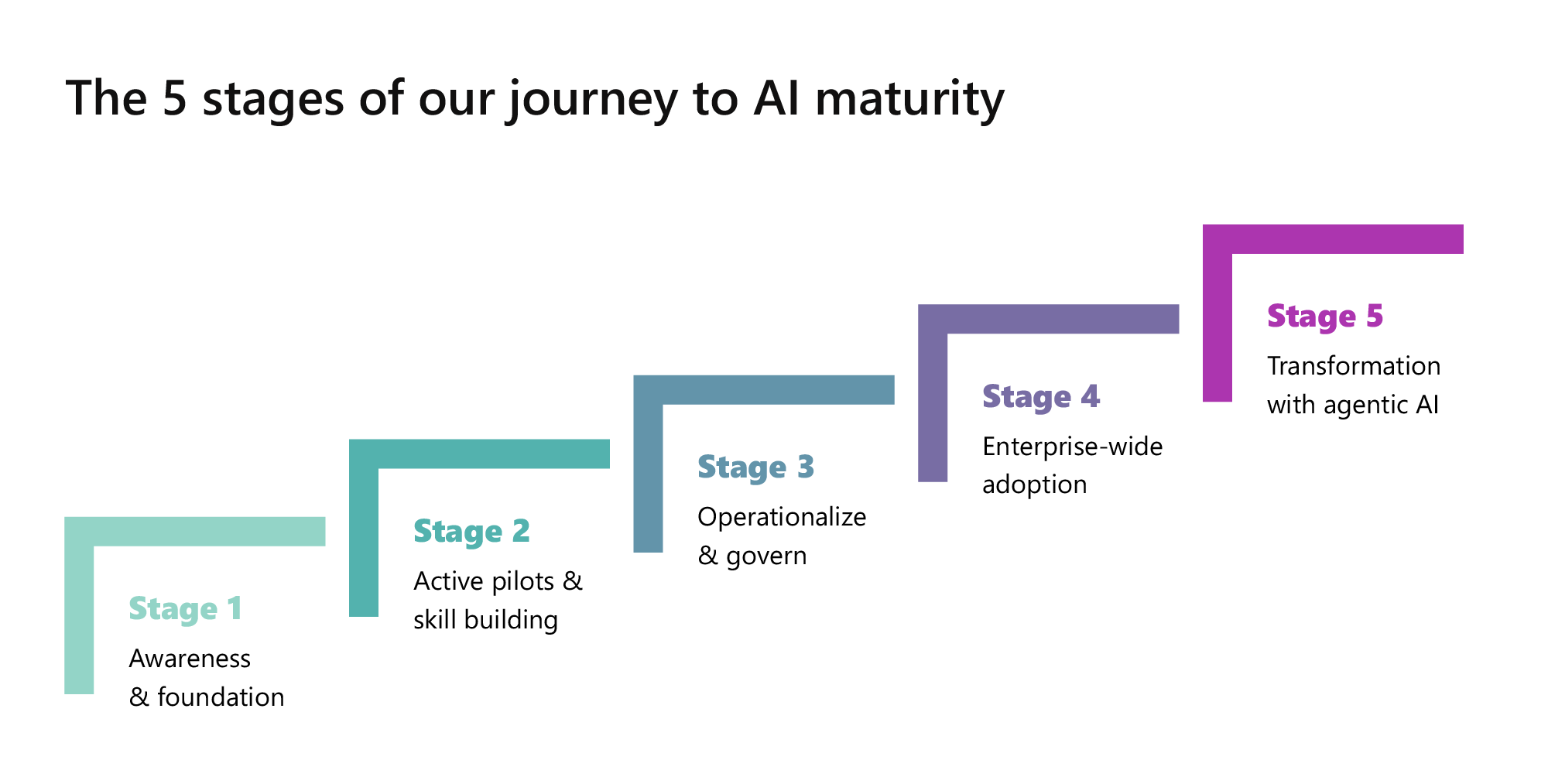
Implementing agents across your organization is intertwined with your larger AI transformation efforts. At Microsoft, we’ve adopted an escalating maturity model that unfolds across five stages.
Putting the Microsoft AI maturity model into practice
Whatever stage you’re at in your AI journey, you’ll likely experience many of the same challenges and opportunities we do at Microsoft.
Stage 1: Awareness and foundation
Building a foundation means setting a bold vision for your AI journey, anchored in clear business outcomes. At this stage, it’s important to engage your executive sponsors early to foster cross-functional collaboration and empower experimentation.
At Microsoft, we established our AI Center of Excellence (CoE) to help guide and drive adoption of Microsoft 365 Copilot, as well as a Data Council that powers our AI-ready data strategy. As we’ve moved into the agentic future, these teams have been instrumental in maintaining forward momentum.
The company also established the Office of Responsible AI (ORA) to advance AI development, deployment, and secure and trustworthy innovation through governance, legal expertise, internal practice, public policy, and guidance on sensitive uses and emerging technology. ORA partners closely with product and engineering teams alongside other trust domains like privacy, digital safety, security, and accessibility to align our work with Microsoft’s six responsible AI principles:
- Fairness
- Reliability and safety
- Privacy and security
- Transparency
- Accountability
- Inclusiveness

Target outcomes include
A foundational strategy, governance principles, and leadership buy-in to kickstart AI projects.
Stage 2: Active pilot programs and skill building
We started by launching targeted pilot projects across different areas of the company. This process encouraged experimentation and used hackathons to surface a broad range of ideas. From there, we selected the most promising initiatives by evaluating business value against implementation effort and focused resources on a select group of high-impact projects.
To establish early-stage governance, we required all pilots to undergo responsible AI and architectural reviews.
Target outcomes include
The first tangible benefits of AI, including efficiency gains, time and cost savings, quality improvements, and an emerging internal talent pool that paves the way to scale successful solutions.
Stage 3: Operationalize and govern
At this point, we worked to scale and integrate AI solutions across the company. We strengthened our data and AI infrastructure to support this transition by formalizing enterprise governance with clearly defined steering teams. Our AI CoE, Data Council, and Office of Responsible AI helped accelerate implementation, ensure the ongoing quality of structured data, and oversee ethical AI use and compliance. Collaboration among these groups was crucial for ensuring our AI initiatives remained within acceptable bounds while delivering tangible business impacts.
Target outcomes include
Multiple AI use cases running at enterprise scale under robust oversight, with cross-functional alignment on AI objectives and the business value they’re delivering.
Stage 4: Enterprise-wide adoption
To consolidate our gains and achieve AI adoption across the enterprise, we prioritized making AI a core consideration in every new project and process by asking where AI-driven intelligence could deliver real impact. That could be by boosting efficiency, enhancing user experiences, or unlocking new business value. From there, we aligned our AI initiatives with our organization’s strategic goals by empowering business leads to synchronize efforts and continuously update our AI roadmap.
We also cultivated a data-driven culture through ongoing, large-scale training while making AI tools a natural part of everyday work. To accomplish that, we established rigorous impact tracking with clear measurement of the amount of value delivered. Key metrics include time savings, cost reduction, and quality improvements. We reviewed these outcomes regularly at the leadership level to maintain accountability.
Our Continuous Improvement CoE has been instrumental in the process of aligning AI initiatives with our organizational goals and providing a framework for progress. It operates according to four principles:
- A clear definition of winning, based on expectations
- Disciplined execution
- Constrained problem-solving with urgency
- Sustained replication and acceleration
Target outcomes include
Measurable, data-driven monitoring of AI for your business that’s powered by a continuous improvement mindset.
Stage 5: Transforming your business with agentic AI
At stage five, we’ve been working to embed AI into every aspect of our operations and culture. We started by leveraging the expertise of our AI CoE to foster innovation, drive continuous improvement, and keep our AI initiatives evolving using structured mechanisms like a Kaizen funnel to crowdsource, prioritize, and advance ideas that extend the impact of AI across the enterprise.
We also further strengthened governance to address the advanced challenges of agentic applications, including responsible scaling of generative AI and effective mitigation of AI hallucinations. Finally, we focused on refining human-AI collaboration so our teams can offload routine tasks to AI agents and concentrate on higher-value work.
One tactic that’s been highly successful here at Microsoft Digital is conducting “Fix, Hack, Learn” weeks, where we encourage employees to identify opportunities for improving our services. So far, these initiatives have yielded multiple AI-powered breakthroughs that are already in production.
Target outcomes include
Significant efficiency gains and innovations from AI, including recognition as a leader in enterprise AI adoption.
As you advance along the AI maturity curve at your organization, keep these essential ingredients in mind:
- Executive sponsorship and governance
- Responsible AI by design
- Data foundations, architecture reviews, and technical readiness
- Talent, skills, and culture
- Impact tracking and accountability
- Change management and communication
- Continuous improvement, innovation, and partnerships
It’s important to remember that these elements aren’t static, but iterative. You’ll need to continue to evolve them over time as your enterprise AI transformation continues. But the five stages of enterprise AI maturity we’ve outlined in this chapter form an overarching framework to keep you moving forward.
Learning from our agent implementation experience

Invest in data infrastructure and AI platforms
Building robust data infrastructure ensures your organization is prepared to leverage AI, supporting scalable, innovative, and secure AI-driven solutions.

Foster a culture of innovation and collaboration
Champion an AI-forward culture where innovation and collaboration drive the adoption of agentic AI.

Align AI initiatives with strategic business goals
Ensuring AI initiatives align with business goals maximizes impact and positions your organization to succeed in the rapidly evolving world of agentic AI.

Implement ethical practices based on our responsible AI principles
Adopting ethical AI practices builds trust, ensures responsible innovation, and prepares your organization to navigate the evolving landscape as AI becomes central to business operations and decision-making.

Position IT to facilitate the transition to a Frontier Firm
At a minimum, your IT leaders and practitioners need to prepare your data estate for agentic workloads, partner to identify and enable prioritized business scenarios, and then actively participate in enterprise transformation through skilling, change management, and measurement activities.

Evolve your enterprise IT infrastructure to embrace dynamic and adaptive agent-based systems
Moving from traditional deterministic systems to agentic systems that introduce probabilistic behaviors, autonomous decision-making, and continuous learning requires new architectural thinking, audit capabilities, and governance models.
Key takeaways
Here are some key tips for implementing agents at your organization, based on what we’ve learned through our own experience here at Microsoft:
- Align agent efforts with business priorities: Partner with leadership to establish clear business priorities that guide agent adoption and investment.
- Define success and how you’ll measure it: Determine business goals and metrics of success that allow you to track impact and value over time.
- Put the right governance structures in place: Establish steering committees across implementation, data, responsible AI, and continuous improvement to guide decision-making.
- Start with early adopters and focused pilots: Identify enthusiastic users and promising pilot programs to validate value and refine your approach.
- Scale what works across the enterprise: Determine which initiatives deliver the greatest value and are ready for broader, enterprise-wide adoption.
- Support change through targeted skilling and enablement: Develop skilling and change management strategies that address the needs of both technical and nontechnical employees.
Learn more
How we did it at Microsoft
- Take a look inside the councils steering AI projects at Microsoft. This article describes the overall impact of our AI CoE, data council, and Office of Responsible AI at Microsoft.
- See how we’re building an AI-powered continuous improvement culture at Microsoft. This story outlines the work of our Continuous Improvement CoE as it identifies and tracks AI opportunities at Microsoft.
- Learn how we’re unleashing API-powered agents at Microsoft. This article shares our internal learnings and a step-by-step guide.
Further guidance for you
- Follow the Microsoft 365 Copilot Agents Deployment Blueprint to enable agents at scale with security, governance, and measurement strategies.
- Microsoft Copilot Studio implementation guidance on how to plan, build, manage, and improve Copilot Studio agents.
- Get our AI Agent adoption guidance for planning, governing, building, and managing AI agents across your organization.
- Define your solution architecture with architecture-level guidance for designing scalable, enterprise-ready agents.
Chapter 3: Driving adoption to capture value across the organization
Readying our workforce for the agentic future through targeted enablement, skilling, and cross-company collaboration
Change management is an important part of our AI maturity journey. All the technical readiness in the world means nothing if we don’t build a transformative culture. The spectrum of agents, use cases, and creation methods is wide, but enabling them all requires one thing: an AI-first mindset.
“An important part of agentic adoption is telling stories to help people understand where AI’s value comes alive or why they should build agents. Examples from peers and real-world use cases are two of our most effective methods for getting people into the AI-first mindset.”
Amy Rosenkranz, principal product manager, Copilot Extensibility team, Microsoft Digital
Driving adoption for agents represents a fundamental shift from an AI assistant like Microsoft 365 Copilot, which delivers a comparable experience for every employee. With the agentic mindset, the point is for individuals to be selective about the agents they choose to use—and more significantly, the agents they choose to create.
We also structure our enablement efforts to channel employees into different behaviors based on what’s available and what they might need to build:
- First, we enable employees to discover and use agents that are already published and available.
- If an agent that serves their use case doesn’t exist, employees can build their own, starting with simple no-code agents.
- For complex agents, we channel employees, teams, and lines of business into using Copilot Studio and other, more full-featured pro-code tools.
Regardless of the behavior we’re trying to enable, we follow a four-phase strategy that takes inspiration from Prosci’s ADKAR model, which progresses through awareness, desire, knowledge, ability, and reinforcement. Our adoption efforts align with the Microsoft Engagement Framework, which we’ve developed specially for driving adoption of our products. You can learn more about our overarching approach in our Microsoft 365 Copilot readiness guide.
“An important part of agentic adoption is telling stories to help people understand where AI’s value comes alive or why they should build agents,” says Amy Rosenkranz, a principal product manager on the Copilot Extensibility team within Microsoft Digital. “Examples from peers and real-world use cases are two of our most effective methods for getting people into the AI-first mindset.”
We’re applying several tried-and-tested change management techniques to our organization-wide adoption efforts. These are relevant to both non-developer employees who want to create simple agents and professional developers working on tools for their teams, lines of business, and the entire enterprise.
Cohort-based coordination
We divide our adoption campaigns along two pivots: Internal organizations like legal or sales and marketing, and regions like North America or Europe. Different cohorts have different focuses, but the strategy is similar. Our company-wide adoption leads spearhead our efforts, and we identify members of target cohorts who can support the adoption, including change managers, leadership sponsors, and employee champions.
Adoption communications
We treat internal communications as a primary driver of agent adoption and creation, not just a distribution channel for training. Our initial communications focused on building confidence, reducing fear, and reinforcing clear norms for responsible agent building. We used consistent messaging across leadership communications, learning content, and employee channels to normalize experimentation and help employees understand when to create an agent, when to reuse one, and where to go for guidance.
AI Agent Launchpad
During our deployment of Microsoft 365 Copilot, we experimented with event-driven skilling in the form of Camp Copilot and Copilot Expo. Now, we’ve adapted these kinds of skilling events to agents as well. AI Agent Launchpad takes employees on a learning path through five modules to help them discover, use, and build agents confidently:
- AI mindset in motion: Employees learn about the concept of the Frontier Firm.
- Introduction to agents: This module covers the basic principles and definitions of AI agents to establish a foundation of understanding for agent creation and usage.
- Explore existing agents: Participants build the new habit of discovering available agents to see if any existing tools meet their needs.
- Build agents with ease: Employees polish their agent building skills in Copilot Chat and SharePoint with an expert in a hands-on lab environment.
- Build with Copilot Studio: This module goes deeper into designing, connecting, testing, and publishing more powerful agents.
Each module features self-learning readiness, live sessions, gamification, and Credly badges. Instead of a global, centralized event, we’ve modularized the experience so local or organization-level leaders can adapt it to their particular cohort’s needs, while still providing support from centralized adoption leads. We’ve also created a freely available resource organizations can use to plan and run their own virtual skilling events around AI adoption.
Copilot builder champs
Our initial AI rollout showed us first-hand the power of peer leadership in driving adoption, so we adapted the strategy behind our highly successful Copilot Champs Community into our Copilot builder champs program. This initiative makes use of peer connections, success stories, and a Viva Engage community, and we refocused it on enabling employees to create the agentic solutions they need.
These champions represent some of our strongest adoption evangelists on their respective teams. We also created a Microsoft SharePoint hub with resources, best practices, agent publishing information, and more.
Integration and incentivization
We collaborate with managers to integrate AI into their teams’ routines. Often, we’ll use mini-challenges or gamification strategies to encourage agent usage. We recognize top contributors with shout-outs or small awards. We’ve also found that it makes these efforts more engaging to blend work tasks with personal interests.
Formalizing change management for professional developers
We apply more focused adoption initiatives for the professional developers who create team, line-of-business, and enterprise agents. Because their efforts are reimagining how work gets done across the organization, we need to ensure these agents are aligned with business goals, built securely and responsibly, and drive the impact the company needs. The process unfolds across five steps.
1. Driving product adoption
This step echoes our broader adoption initiatives. We cultivate leadership alignment and sponsorship, comprehensive communication plans, training and upskilling programs, champion-led peer support, and integration into daily work with incentives.
2. Agent ideation and development
Here, we capture high-value use cases by mapping out processes and pain points we could improve with agents. Then we prioritize and select pilots and empower small interdisciplinary teams to build, test, and refine those agents.
3. Agent discovery and advocacy
Once we’ve completed our pilot programs, we identify the agents with the most potential impact, broaden their development, establish a catalog for observability and discoverability, and showcase success stories.
4. Workforce transformation
At this point, we’re ready to map workflows for human-AI optimization, capture scenarios that are especially useful for key roles, commit to wider AI skills training, develop our workforce into “agent bosses,” and work to measure and communicate impact.
5. Feedback and listening
Tracking the impact of your efforts is crucial. We established a feedback loop to drive further success through telemetry and analytics, employee feedback, and insights from our support channels and FAQs. Then we analyze and triage those insights and close the loop with users by communicating how their feedback drives change.
Whatever your goals and whichever segment of your workforce you target, it’s important to understand that adoption doesn’t happen by accident. True workforce transformation won’t take place without appropriate adoption activities.
As you launch your own adoption initiatives, consider who your audience is, what they need to build confidence and competence, and how you can unlock agentic value for them across your organization.
Learning from our agent adoption experience

Be thoughtful about your audience
Vary your efforts between non-developer and developer audiences, different geographies and internal organizations, and specific goals. Put together a methodology for thinking about what agents you want and what benefits they’ll provide, then determine who the best builder is.

Don’t just enable agents—empower the enterprise
Your goal isn’t just to activate agents for agents’ sake. Think carefully about what workflows and value you’re trying to unlock, and how agents can get you there. Break down aspects of roles and workflows, and see how agents fit in.

Establish multiple vectors for skilling
Different modalities work for different employees. Use every tool at your disposal, from live events to peer leadership to self-guided learning, and communicate them across all available channels.

In many ways, this is a reset
Your employees may have just become comfortable with Copilot, and agents might feel like a whole new horizon. That’s true. Have patience and understand that this is an entirely separate adoption path.

Showcase and celebrate success
People need to see value and possibilities for agents in their own work. When pilots or personal agents create results, socialize them widely and encourage employees to try them out. Nothing encourages experimentation with agents like successful usage.

Leadership sponsorship is absolutely crucial
Leaders both set expectations and bear the standard of your organization’s culture. They can be the figureheads of transformation by setting priorities, participating in communications, and leading by example.
Key takeaways
Here are some important steps to keep in mind as you embark on your own adoption and change management efforts for agents:
- Establish strong adoption leadership early: Assign a dedicated adoption lead, form a cross-functional adoption team, and align change managers, executive sponsors, and employee champions around clear ownership and cadence.
- Design adoption around real work and real people: Identify priority cohorts, personas, and usage scenarios, then tailor messaging, enablement, and communications to how each group works and learns.
- Define success before you deploy: Set clear KPIs and success criteria likefeature usage, scenario adoption, and employee sentiment, and put a measurement and feedback plan in place from day one.
- Enable employees through structured onboarding and learning: Combine readiness communications, live learning, self-service resources, and a centralized enablement asset library to help employees build confidence and momentum.
- Activate champions and leadership to amplify adoption: Launch champion communities, empower leaders to model usage, and use internal channels to reinforce behaviors and share progress.
- Continuously listen, learn, and iterate: Gather feedback through surveys and listening sessions, surface success stories, and apply insights to refine adoption, reinforcement, and resistance management plans.
- Extend and optimize for professional developer teams: Support advanced agent ideation, development, discovery, and advocacy while using ongoing feedback to drive workforce transformation at scale.
Learn more
How we did it at Microsoft
- Revisit our adoption practices for Copilot. This chapter of our Copilot readiness guide will help lay a base for your understanding of AI adoption practices.
- See how we made AI engagement fun with Camp Copilot. This article tells the story of our skilling event series to show you how this kind of initiative could look at your organization.
- Try our 7 tips for driving Microsoft 365 Copilot adoption with a virtual skilling event. This post distills our learnings from Camp Copilot into a handy list for change leaders.
- See how we enabled meaningful AI adoption with a Microsoft 365 Copilot Expo. This story outlines our follow-up and evolution of the Camp Copilot experience into Copilot Expo, a more flexible and modular skilling event.
- Learn how we drove Microsoft 365 Copilot adoption with our Copilot Champs Community. This article showcases the peer leadership efforts that supported Copilot adoption at Microsoft.
Further guidance for you
- Download the Agentic Automation Adoption Guide to learn migration strategies, governance models, and business value for agentic automation.
- Explore the company’s official AI agent adoption guidance to plan, govern, and operate agents using proven frameworks and best practices.
- Visit the AI Agents Hub on Microsoft Adoption to access webinars, quick-start guides, and business scenarios for Copilot, Foundry, and Copilot Studio.
- Check out our Copilot user engagement tools and templates, which we used to encourage adoption across our organization.
Chapter 4: Providing support at the agentic frontier
Bolstering agentic transformation through solid groundwork, human oversight, and AI-driven support
With many forms of technology, support is fairly simple. You identify pain points and common issues with a relatively static technology, create self-service tools to help users with those challenges, and make subject matter experts available in the form of a dedicated support team.
But AI is evolving too quickly for that model, and agents are too diverse and individualized for a static approach. As a result, our support apparatus for agents needs to be much more flexible. Within Microsoft Digital, our goal is to make it easy for employees to engage with agentic tools freely and adaptably while maintaining safety and responsibility.
The path to this objective relies on a three-pronged approach to governance:
- Embedded governance functionality: The ideal state is that our agent creation and publishing tools should incorporate good guidance, governance, and guardrails out of the box so the agents people create are essentially self-governing.
- IT oversight: This is a new space and a new way of working, so it isn’t feasible for all agents to self-govern at this point. As an IT organization, Microsoft Digital fills gaps in governance through reviews and oversight. We do this by establishing risk-based policies around types of agents, exposure and sharing, and other pivots we addressed in our governance chapter.
- User education: It’s almost impossible to predict every governance gap and need, so educating our users helps them avoid accidentally stepping out of bounds. Our Agents at Microsoft team and change managers are the linchpins of these efforts, and employees can lean on resources like Microsoft Learn courses and the Agent Builders SharePoint hub.
Of course, we do have a support team of AI subject matter experts available to employees for any questions they can’t answer themselves. Our HelpDesk support team operates independently from other enablement vehicles, but human support representatives can only accomplish so much. It’s important not to create bottlenecks by relying on conventional support. After all, the promise of AI is to reduce the burden on humans, and that’s no different for our support teams.

“On our journey to Frontier Firm, we’re working really hard to accelerate processes and remove roadblocks so people can get to value much faster. This is crucial for agentic scenarios because we’re using these iterations to polish and improve the tools we create.”
Mykhailo Sydorchuk, Customer Zero lead for Microsoft 365 integrated experiences, Microsoft Digital
AI itself is becoming a cornerstone solution for this challenge. An AI-driven approach aligns with the idea of the Frontier Firm, where humans lead and agents operate, in this case by supporting other humans as they explore AI more deeply.
This is a relatively new approach, but we’re already using agents to provide support in several ways:
- We operate an agent called Ask MICA (Microsoft Intelligent Compliance Agent). This tool provides information and support for compliance issues.
- Agents help us evaluate the risk profiles of other agents. Automating risk assessment accelerates publishing by minimizing human reviews or questions to support specialists.
- We use an agent to perform checks against standards for responsible AI, security, privacy, and access to sensitive information.
- We’re also partnering with our product groups to develop automated agent-building enablers and accelerators that can support ideation and evaluation for new ideas instead of relying on groups like the AI CoE to step in for that kind of support.
In reimagining the support experience this way, we’re focused on maximizing efficiency so that humans remain in the loop, but only for edge cases where AI can’t help. That’s the best use of their time and unique human talent. Meanwhile, we’re continuing to develop and implement agents to support employees for increasing numbers of non-edge cases.
Continuous improvement practices help propel this work forward. Much of that work comes from targeted conversations around pain points. For example, an agent builder might share that it’s taking too long to get security reviews for their projects. To us, that signifies that a security review agent may be useful.
“On our journey to Frontier Firm, we’re working really hard to accelerate processes and remove roadblocks so people can get to value much faster,” says Mykhailo Sydorchuk, a Customer Zero lead for Microsoft 365 integrated experiences at Microsoft Digital. “This is crucial for agentic scenarios because we’re using these iterations to polish and improve the tools we create.”
It’s important to remember that humans will always need to be involved in supporting other humans. But the more assistance agents can provide your support specialists, the more they can focus on tasks that absolutely require human attention. As you consider where AI might fit into your support efforts, our journey can shed some light on the possibilities agents represent.
Learning from our experience with providing support around agents

Emphasize proven agents to minimize the need for support
If you’ve built dedicated first-party agents within your organization, encourage employees to favor those through internal communications. They’re less likely to require support in the first place.

Identify opportunities for AI-driven support
Listen to employees’ pain points and concerns. Recurring themes and issues probably mean there’s an opportunity for agentic support.

Meld adoption and support
Education and skilling initiatives build employee competency to minimize their need for support. If people understand standard use cases thoroughly or know where they can find the right information, they’re more likely to reach out to support specialists only on real edge cases.

Backstop support as much as possible
Microsoft is working to make our tools as self-service as possible. Where gaps appear for your organization’s specific use cases, fill those with IT backstops and employee enablement resources. Hopefully, your support team can be your final resort.
Key takeaways
Here are some key things to remember as you develop your support plan for agents at your company:
- Build agent expertise within support teams early: Provide targeted training, skilling, and early access so support teams can become trusted agent subject matter experts.
- Reduce support demand through proactive enablement: Identify IT backstops and employee enablement opportunities that prevent common issues before they require support intervention.
- Operationalize agentic support at scale: Identify recurring issues across non-developers and professional developers, select high-value opportunities for agentic support, build and test support agents, and actively promote them to drive adoption.
Learn more
How we did it at Microsoft
- Revisit our support practices for Copilot. This chapter will help you lay a base of understanding for AI adoption practices.
- Access our eight steps for managing your support team content with AI tools. This resource demonstrates one way AI can boost your support team’s efforts.
- See how AI is revolutionizing the way we support corporate functions at Microsoft. This story outlines ways that AI tools can contour to different functions across your organization.
Further guidance for you
- Get our Microsoft Agent 365 overview documentation for our control plane for managing, governing, and securing agents across the enterprise.
- Learn how to manage AI agents across your organization. This article provides guidance on integrating AI agents into business workflows and managing their lifecycle from deployment to retirement.
Chapter 5: Tracking the impact of your agents
Building the apparatus for effective measurement to ensure our agentic ecosystem drives business value
Effective governance, implementation, adoption, and support don’t mean anything if your agents aren’t driving the impact your organization wants. But how do you understand that impact if you can’t track and measure it? And what should your measurement criteria be?
Within Microsoft Digital and the company’s leadership team, we’re currently thinking through these ideas to ensure we’re capturing all the value agents have to offer. We’re still developing our approach, but the questions we’ve asked and our measurement parameters will be helpful to consider as you track your own agents’ impact.
First, there’s a difference between tracking agent volume, agent usage, and agent value. Employees creating massive numbers of agents that never get used don’t drive impact. Agent usage is closer to the mark, and it can be a good indicator of which tools are meaningful to employees or might deserve potential promotion for use throughout your organization. Still, usage doesn’t necessarily correlate to business value.
To really articulate value, you need to dive into the specifics of what you intend your agents to do. There are several dimensions to consider:
- Types of agents: First-party enterprise agents, third-party agents, line-of-business or team-based tools and individually created agents all have different purposes and capabilities. They need different measurement strategies.
- Personas: Who is creating the agent, and what are their maturity and needs? What value does a user get compared with a developer or administrator? There’s also team versus individual value. For teams, we tend to measure impact in terms of workflows automated or pain points relieved. For individual users, it’s all about satisfaction, productivity, quality, and efficiency gains.
- Data: Different agents access varying degrees of data. How do you assess the ways they provide access and deliver insights?
- Creation versus discovery and usage: We want to encourage both agent creation when it meets a unique need and agent discovery when a useful agent already exists. Each requires its own measurement parameters.
Our roadmap to agentic impact tracking
We aren’t starting from scratch when it comes to tracking agentic impact. Our Continuous Improvement CoE has already done extensive work aligning targeted and sanctioned AI initiatives with greater business value and tracking them over time. The concept is based on defining top-level value, cascading that value into operational drivers that deliver results, creating action plans and delivering AI solutions to achieve those goals, and then tracking them over time.
We’re currently progressing along a roadmap to a more holistic impact tracking methodology we can use to identify, consolidate, and build agent analytics for all makers, developers, administrators, and Microsoft Digital teams. As time goes on, this approach will accelerate product improvements, improve the builder experience, and cater to reporting and analysis requirements.
Our journey has three main goals:
- Authoritative, clean, deduplicated data
- A baseline for creation and usage, and well-defined key performance indicator (KPI) targets
- Advanced insights to accelerate the agentic ecosystem at Microsoft
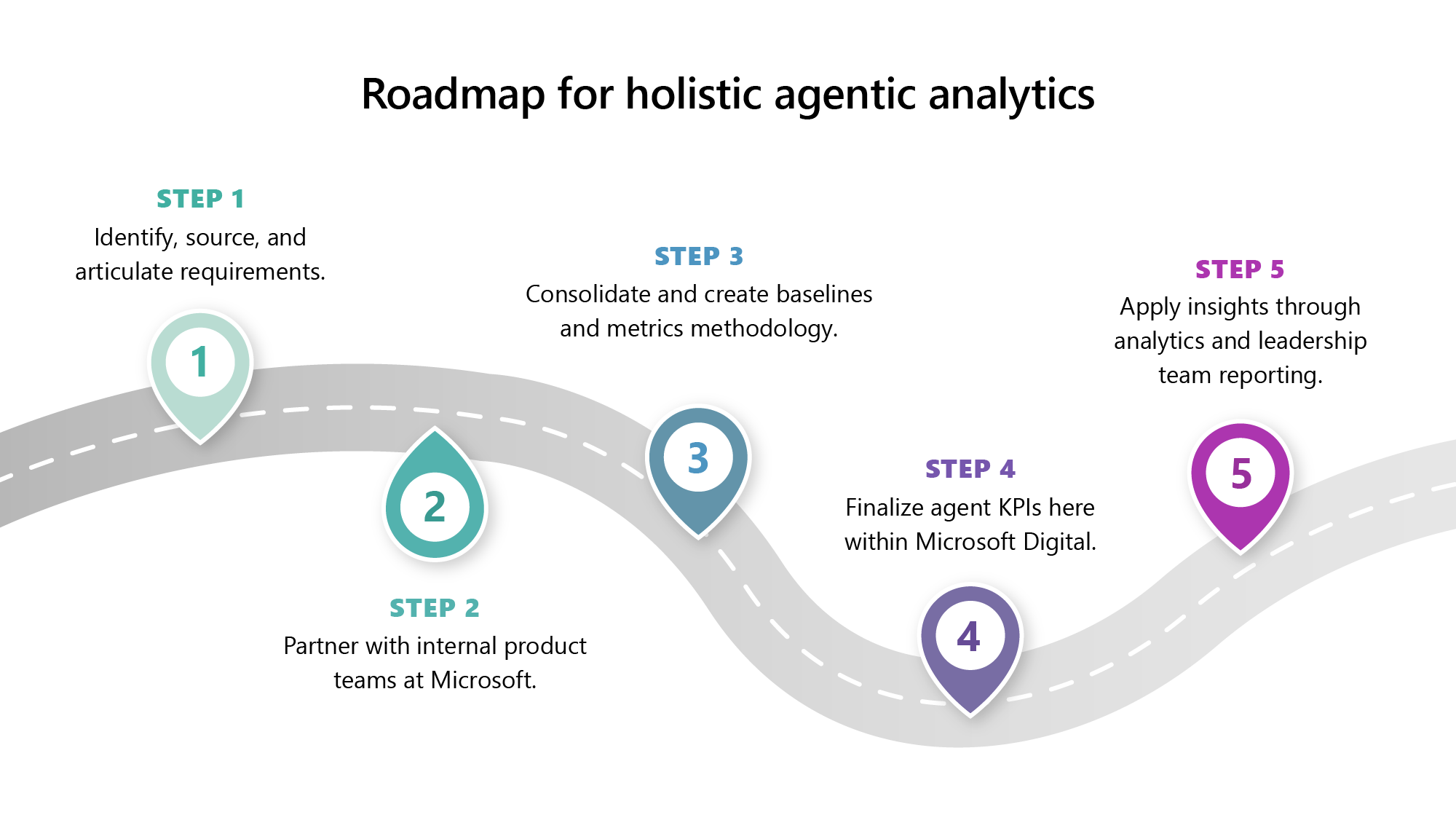
In service of these goals, we’re progressing through a five-phase process:
As this methodological structure for tracking agentic impact has come together, we’ve used various tools to help us gain visibility. These include Viva Insights, Microsoft 365 admin center, and an internally built declarative agent tracker, with visibility typically provided by Microsoft Power BI. With the release of Microsoft Agent 365, now available through the Frontier program, we’ve gained a more streamlined vehicle for observability and telemetry.
Three feature sets will be especially useful for tracking value:
- Registry provides a complete view of agents to give us maximum visibility and trackability across our entire agentic ecosystem.
- Visualization includes measurement features to track agent performance, speed, and quality so we can assess ROI and make informed deployment decisions.
- Interoperability ensures we can connect to an open ecosystem of both Microsoft and partner tools.
As Customer Zero for Agent 365, we’re excited to have a platform for observability and telemetry that encompasses everything from agentic creation through usage.
We plan to use the following capabilities to improve the overall ecosystem:
- Filtering our agent inventory on specific criteria like the type of agent or how it was built
- Enhancing governance-specific actions we can take with agents in areas like ownership and quarantining
- Gaining visibility into trends like agent usage
- Ingesting agent blueprints and defining policy templates
We’re still in the midst of our agentic measurement journey at Microsoft, but the blueprint for tracking already exists. Your organization may be in the early stages of agent readiness and deployment. If that’s the case, it will be helpful for you to internalize the lessons we’ve learned as Customer Zero and apply them as early as possible in your own journey to AI maturity.
Learning from our approach to tracking agentic impact

Think proactively, not retroactively
If you put effort into tracking agentic impact early in your AI maturity journey, you’ll be poised to start capturing insights immediately instead of applying your methodology after the fact.

Involve a wide array of stakeholders
This workstream needs oversight from different kinds of stakeholders, including your leadership team, IT, Microsoft 365 administrators, agent developers and builds, and employee champions. That will provide the sponsorship, expertise, and perspective you need for success.

Establish a continuum of value
Agents need to tie into real business goals, so it’s important to establish metrics that actually speak to those objectives. Cascade business goals to concrete KPIs with well-defined timelines and track those diligently.

Embrace the red
Try to think of underperformance not as failure, but as data. Performance data over time helps you course correct or pivot, making sure you invest where it matters.
Key takeaways
Here are some tips as you develop a strategy for measuring the impact of agents at your organization:
- Assemble a cross-functional analytics and adoption team: Bring leadership, IT, Microsoft 365 administrators, agent builders, and employee champions together to ensure shared ownership and accountability.
- Clarify analytics and insight requirements up front: Identify, source, and clearly articulate the data and insights needed to measure agent adoption and impact.
- Build an analytics foundation and iterate over time: Consolidate data sources, establish baselines, and develop initial analytics that can evolve as usage grows.
- Define and standardize agent KPIs: Finalize a clear, consistent set of metrics aligned to business outcomes and adoption goals.
- Turn insights into action through reporting: Apply analytics and reporting to inform decisions, optimize adoption efforts, and drive continuous improvement.
Learn more
How we did it at Microsoft
- Find out how we’re deploying Microsoft Agent 365 internally. This story shares our intentions for using our unified control pane for agents.
- See how we’re building an AI-powered continuous improvement culture at Microsoft. This article outlines our approach to continuous improvement.
- Learn how we’re reshaping Microsoft with continuous improvement and AI. This post discusses the importance of continuous improvement for accelerating AI at Microsoft, including three initiatives already underway.
Further guidance for you
- Read this guide for measuring adoption and business value with Copilot Analytics.
- Get our guidance on using Microsoft 365 admin center activity reports. This resource shows you how to get insights into how people in your business are using Microsoft 365 services.
Applying lessons from our agent deployment at your organization
You’ve learned from our AI maturity journey. It’s time to get started on yours.
Becoming a Frontier Firm might seem daunting. But the agent-building and agent-adoption practices we’ve articulated in this guide can help you gradually and thoughtfully progress toward a new organizational blueprint, one that blends machine intelligence with human judgment. It can help you build systems that are AI-operated but human-led.
By capitalizing on the lessons we’ve learned during our internal deployment, you can both speed up the process of building and deploying agents at your company while avoiding frustrating pitfalls. If you anchor your work in careful planning and use the steps and resources we’ve provided here, you’ll be on the path toward true business transformation through agentic workflows.

“Embracing AI transformation is an opportunity for IT leaders to take part in defining the future of their organizations. Our role as technical professionals has never been more revolutionary, and our team can support yours as you reimagine workflows to make AI part of your everyday reality.”
Vijaya Alaparthi, principal group product manager, Microsoft Digital
You’re not in this alone. If you’re looking for support or knowledge on any aspect of your deployment, reach out to our customer success team.
“Embracing AI transformation is an opportunity for IT leaders to take part in defining the future of their organizations,” says Vijaya Alaparthi, a principal group product manager at Microsoft Digital. “Our role as technical professionals has never been more revolutionary, and our team can support yours as you reimagine workflows to make AI part of your everyday reality.”
Frontier opportunities are present across every aspect of your organization today. Partner with us and take your first steps toward this exciting agentic future.
Key takeaways
This guide captures what we’ve learned as we’ve deployed agents across our entire global organization. Here are the key things to remember as your company moves from early AI adoption to a large and thriving agentic ecosystem:
- Advance governance early: Establish a strong and trusted data foundation that includes labeling, protections, and a risk-based governance model before enabling broad agent creation. Establishing your governance foundations for Microsoft 365 provides the confidence to open up Copilot without hiding data. Clear guardrails, differentiated oversight, and lifecycle management help ensure safe innovation without sprawl.
- Follow a maturity roadmap: Use an escalating AI maturity model that progresses from awareness to enterprise-wide adoption and agentic transformation to sequence your rollout. This staged approach aligns AI investments with business goals while building the culture, skills, and infrastructure you need to scale.
- Drive targeted adoption: Treat agent adoption as its own transformation journey, distinct from assistant-based tools like Microsoft 365 Copilot. Cohort-driven skilling, champion communities, localized learning, and leader-led communications accelerate confidence and empower both makers and users.
- Empower builders at all levels: Support no-code creators and professional developers with tailored enablement, clear publishing workflows, and accessible resources. This ensures individuals can create personal agents while teams can safely build enterprise-grade tools that unlock high-value scenarios.
- Reimagine support with AI: Blend embedded governance, flexible IT backstops, and AI-driven support agents to reduce friction and scale help resources. As employees experiment with agents, automated checks, accelerators, and intelligent support tools keep humans focused on true edge cases.
- Track impact holistically: Distinguish between agent creation, usage, and value by establishing KPIs that map directly to real business outcomes. A unified telemetry and observability layer powered by tools like Microsoft Agent 365 enables clear measurement, optimization, and proof of return on investment.
- Continuously evolve toward becoming a Frontier Firm: Advance your culture, architecture, governance, and workforce practices iteratively as agentic capabilities grow. By combining human judgment with autonomous agentic operations, your organization can unlock transformational efficiency, innovation, and scale.
Learn more
How we did it at Microsoft
- Discover how we’re deploying Microsoft Agent 365 internally. This story shares our intentions for using Microsoft’s unified control pane for agents.
- Explore our IT playbook for the AI era and learn how we’re becoming a Frontier Firm. This article shares our journey as an IT organization in support of this new operating model.
- Learn how we’re building an AI-powered continuous improvement culture at Microsoft. This story outlines the work of our Continuous Improvement CoE as it identifies and tracks AI opportunities at Microsoft.
- Access our eight steps for managing your support team content with AI tools. This resource demonstrates one way AI can boost your support team’s efforts.
Further guidance for you
- Secure your agents at scale with Microsoft Agent 365 guidance for unified identity, compliance, and control across platforms.
- Learn about the Responsible AI policies and practices we use to guide our use of AI at Microsoft.
- Follow the Microsoft 365 Copilot Agents Deployment Blueprint to enable agents at scale with security, governance, and measurement strategies.
- Download the Agentic Automation Adoption Guide to learn migration strategies, governance models, and business value for agentic automation.
- Visit the AI Agents Hub on Microsoft Adoption to access webinars, quick-start guides, and business scenarios for Copilot, Foundry, and Copilot Studio.

Try it out

We’d like to hear from you
Want more information? Email us and include a link to this story and we’ll get back to you.