


Andor Health brings AI and clinical capabilities to Microsoft Teams

As 2020 slips into our collective rearview mirror, there is little doubt that the COVID‑19 pandemic had a major impact on virtual healthcare adoption by both consumers and healthcare organizations.
At the onset of the pandemic, Microsoft healthcare customers quickly used their existing investments in Microsoft Teams to deliver virtual visits (clinician to remote patient) and virtual rounding (clinician to in‑hospital patient) to reduce virus exposure and provide continuity in care. As these virtual services have become commonplace, healthcare organizations are now looking to satisfy consumer demand by creating dedicated virtual healthcare capacity and enriching the patient experience for these remote sessions.
Partnering to drive healthcare innovation
The need to connect virtually with patients has fostered rapid innovation and Microsoft partners are designing solutions to increase collaboration and communication for care teams and in communities.
One such partner, Andor Health, developed ThinkAndor™. This new cloud-based software solution leverages machine learning, bots, voice, and workflow signal management and is designed to solve many of the costly, systemic issues surrounding virtual visits. Unlike several other digital healthcare platforms that tackle a discrete element of end-to-end workflow, Andor Health considers the holistic experience of clinician-patient encounters and the relevant, required background IT tasks. Their clinical care orchestration provides digitization, automation, and integration infrastructure to streamline the tasks that occur before, during, and after a patient encounter.
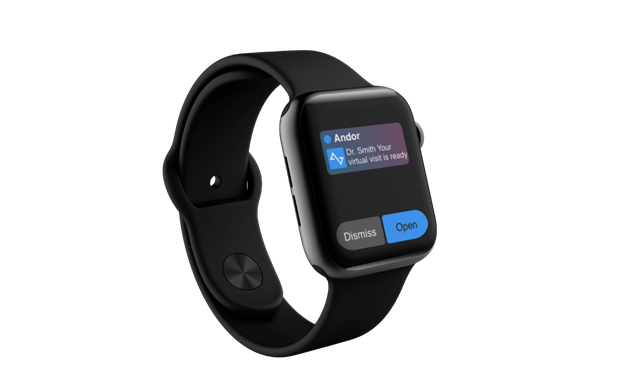
Key ThinkAndor™ features that enhance the Microsoft Teams experience for virtual health include:
- Enabling providers to quickly configure and activate signals from all major EHRs (electronic health records) and source systems to drive innovation in clinical and operational workflows
- Providing connectors and configurations to a wide range of patient journey capabilities such as scheduling, notifications, e-consents, intake/triage, education, eligibility verification, payment gateways/processing, care plan assessments, and patient surveys.
- Delivering configurable and automated patient call backs, closed captions (in 40+ languages), portal enrollment, personalized education, the upload of pertinent documents or images, and the capability to invite family/friends to a virtual health session.
- Providing a virtual waiting room that gives managers and intake specialists a comprehensive view of all virtual health sessions, complete with wait times and patient status. The virtual waiting room can be integrated and embedded in most EHRs to support unified clinician calendars.
Customers of Andor Health’s solution, such as the National Institute of Health, Lakeland Regional Health, and Humana, enable their organizations to better serve patients and deliver superior virtual care experiences. In addition, their customers are already seeing meaningful ROI—patients are missing fewer virtual visits thanks to the virtual visit notifications and call backs. Clinicians are also saving time on clicking through screens and reviewing charts during their patient virtual visits, allowing for more present and empathetic conversations.
Andor Health is another great example of a Microsoft partner delivering innovation for our healthcare customers.
Learn more about Andor Health and ThinkAndor™, available through Microsoft AppSource.