Highlights in this blog
- Watch global leaders discuss the future of industrial intelligence: Register now
- Get the latest insights on industrial transformation: Get the e-book
- New: The Procurement Agent in Dynamics 365 Supply Chain Management
Three global industrial leaders—ABB, Krones, and TK Elevator (TKE)—are redefining their industries by using advanced AI and trusted cloud platforms to become Frontier industrial organizations. With Microsoft, they’re turning data, processes, and context into intelligence that drives efficiency, agility, and innovation. Every Frontier organization gets two fundamental things right: intelligence and trust. They amplify what’s unique in their people and operations with AI that is governed securely on their own terms. Trust isn’t added at the end; it ensures intelligence is used responsibly and outcomes happen as intended. Hannover Messe 2026 is where these transformations take center stage, showing how Frontier organizations are shaping the next era of manufacturing.
- ABB—AI as a Real-Time Industrial Co-Pilot: ABB, a global technology leader in electrification and automation, will showcase its cloud-powered Genix Industrial AI platform running on Microsoft Azure. Genix acts as a real-time industrial co-pilot on the factory floor by analyzing streaming data from equipment and sensors and delivering actionable insights and recommendations to operators and managers in real-time. At Hannover, ABB’s demos illustrate how Genix enables closed-loop, AI-driven optimization of production processes on the fly, for example, by automatically adjusting parameters to improve energy efficiency, asset performance, and reduce unplanned downtime. Designed with a modular, scalable architecture, Genix integrates seamlessly with existing industrial systems, eliminating the need for large‑scale platform replacements and enabling rapid time to value. With the integration of generative and agentic AI, the platform not only provides insights, but also automates actions, while keeping humans “in the loop” for all critical decisions to ensure safety and operational decisions. This approach demonstrates how ABB is moving toward autonomous, self-optimizing operations without sacrificing human oversight, a hallmark of a Frontier organization.
- Krones—From Bottling Machines to “Bottle-as-a-Service”: Krones, one of the world’s largest bottling equipment manufacturers, is using AI to reinvent its business model and engineering process. With Microsoft’s help and the ecosystem of trusted partners Ansys (part of Synopsys), NVIDIA, Softserve, and CADFEM, Krones integrated advanced AI-based fluid simulation into its digital twin of a filling line, packaged with a multi-agent experience, for their engineers to create these complex simulations with natural language queries. This innovation has slashed simulation times from four hours to under five minutes (a 95% reduction), allowing engineers to optimize machine parameters virtually and dramatically shorten commissioning time. The payoff is huge—Krones can now rapidly tailor designs for each customer and ensure optimal throughput. At Hannover Messe 2026, Krones will demonstrate how these AI-powered digital twins let them forecast and fine-tune production faster and more flexibly than ever, turning a traditional machinery business into a Frontier digital services company.
- TK Elevator—Digital-Native Elevators and Agentic AI: TK Elevator (TKE) is revolutionizing mobility for 1.5 billion users by combining digital-native products, secure cloud and data platforms, and agentic AI, all in partnership with Microsoft. At Hannover Messe, TKE highlights its EOX and HELIX elevators, which are eco-efficient, AI-ready, and IoT-enabled as part of the MAX on Azure platform. Azure Databricks supports their unified analytics, ensuring data governance and enabling scalable AI workflows. TKE’s specialized AI agents, alongside the Digital Operations Center, streamline service by assembling contextual briefings before technician visits and capturing insights afterward, turning technician knowledge into organization-wide intelligence.
These three examples are among many Microsoft customers and partners joining us at Hannover Messe 2026, with live demos showing how industrial intelligence turns data into faster decisions, safer operations, and more resilient manufacturing.
Industrial Intelligence Unlocked, Microsoft’s overarching theme for Hannover Messe 2026, reflects the belief that manufacturing’s next era will be driven by human ingenuity and AI—grounded in trust. Microsoft provides a unified intelligence layer for the tools your employees use; Work IQ understands how people collaborate and decide. Fabric IQ delivers real-time visibility across assets, production, and supply chains. And Foundry IQ combines institutional knowledge like procedures, standards, and history with AI. Together, they help manufacturers connect teams, processes, and technology across the value chain.
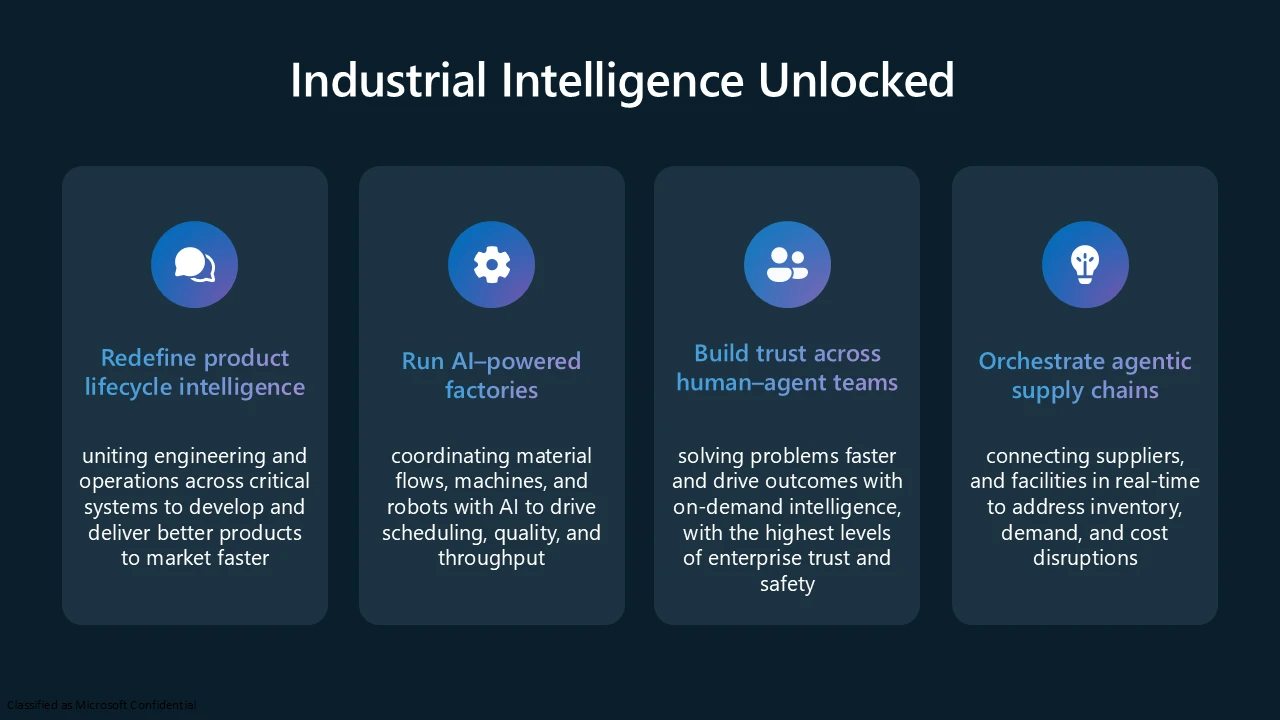
1. Redefine product lifecycle intelligence
This neighborhood focuses on uniting engineering and operations through data-driven intelligence, so manufacturers can design and deliver better products in less time. Here you’ll see how Microsoft is helping companies create a closed-loop product lifecycle —connecting every stage from design and simulation to production feedback. For example, Microsoft and NVIDIA are collaborating to power the next generation of physical AI by integrating NVIDIA Omniverse libraries with Microsoft Fabric.
By blending real-time data, AI, and virtual simulation in one environment, companies can iterate designs faster with greater confidence. Imagine optimizing a new machine design virtually (with accurate physics and live data) before anything is built—reducing costly physical prototypes and accelerating time-to-market.
In short, the product lifecycle intelligence zone shows how integrating data + simulation + AI yields smarter product decisions and faster innovation.
Microsoft ecosystem partners showcased in this area: Aras, Brembo Solutions, Celebal Technology, NVIDIA, PTC, Tata Consultancy Services (TCS)
2. Run AI-powered factories
In our AI-Powered Factories area, we demonstrate how to coordinate machines, materials, and people with AI, turning traditional facilities into adaptive, self-optimizing operations. Microsoft supports the ability to scale these operations with a unified intelligence layer powering AI insights and a consistent framework for managing agents, models, data and infrastructure with the adaptive cloud approach.
A highlight here is Microsoft’s approach to industrial edge AI. Foundry Local on Azure Local enables manufacturers to deploy and run AI models, including those from the Foundry model catalog —directly on factory equipment or on-premises servers for scenarios that require ultra-low latency, data locality, or offline operation. This capability supports high-speed vision inference for quality inspection, anomaly detection, and predictive maintenance, all in real time without relying on constant cloud connectivity. Manufacturers can choose curated open-source models from the managed catalog or deploy custom OCI/Docker models on CPU or GPU systems.
Discover how the latest Azure IoT Operations release simplifies OT data management—now with no-code pipelines, seamless device control from cloud to edge, and direct support for third-party MQTT brokers and Litmus Edge gateways. In addition, upgrades to Azure IoT Hub and firmware analysis, enabled by Azure Arc make it easier for industrial organizations to securely manage and update large device fleets with unified Azure security and certificate management via Azure Device Registry integration. Learn more about how Microsoft and our partners are providing the foundation to initiate and scale industrial AI projects in our two-part blog series: Making Physical AI Practical for Real-World Industrial Operations: Part 1 and Part 2.
Together, these capabilities come to life in Microsoft’s Factory of the Future demo—showing how adaptive cloud, edge intelligence, and Physical AI work together in a real manufacturing environment. The Factory of the Future demo shows how Physical AI comes to life when design, simulation, and execution are connected into a single, adaptive manufacturing system. In collaboration with Hexagon, Siemens, NVIDIA, KUKA, and others, Microsoft demonstrates an end-to-end scenario where AI-assisted product design is validated in simulation and then executed in a live manufacturing cell. Real-time telemetry flows from the factory floor through Azure IoT Operations at the edge and into Microsoft Fabric, where AI agents’ reason across operational signals to proactively detect issues and support action.
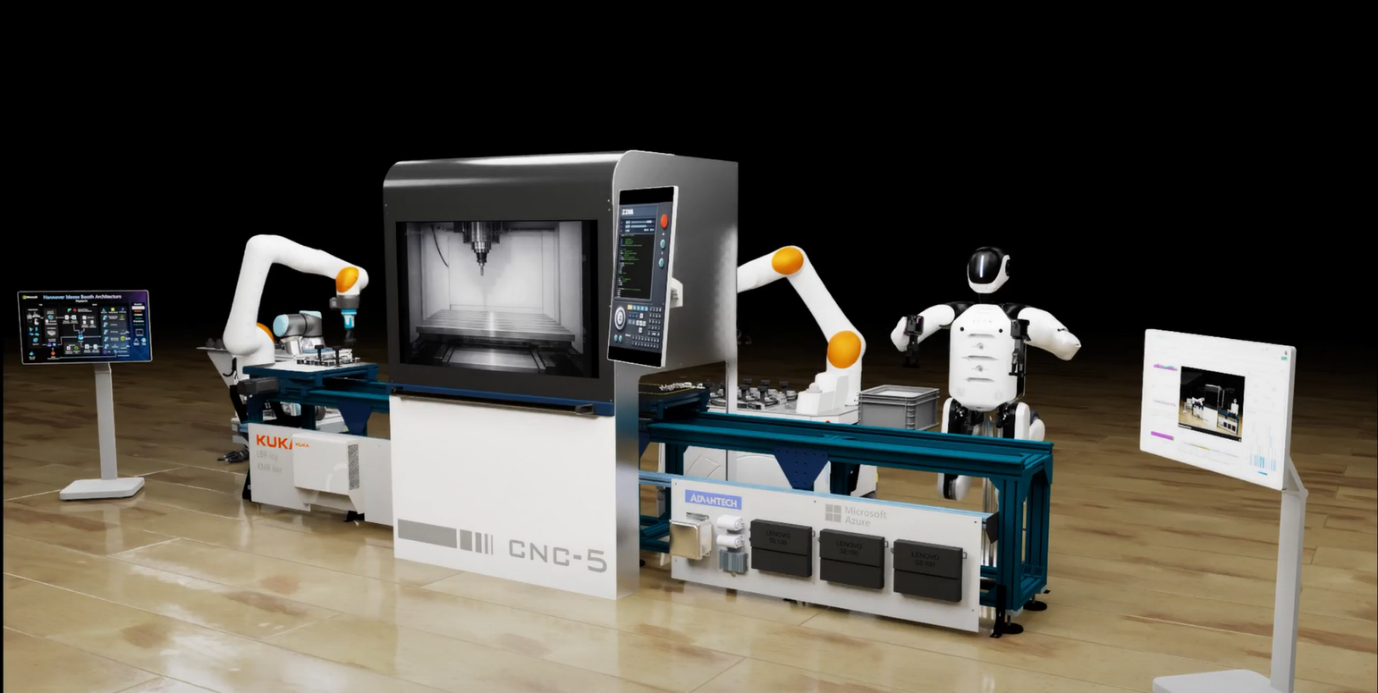
Microsoft ecosystem partners showcased in this area: Accenture Avanade, AVEVA, Hexagon, Kuka, NVIDIA, Schneider Electric, Siemens, Sight Machine, Rockwell Automation
3. Build trust across human–agentic teams
As AI agents move from pilots to daily operations, trust becomes the factor that separates insight from impact. In manufacturing environments, AI only delivers value when people are confident enough to act on its recommendations. For frontline workers, trust means clarity at the moment of action. AI agents assemble contextual briefings that bring together equipment performance, recent alerts, maintenance history, and safety guidance, so technicians arrive informed and prepared. Recommendations are visible, explainable, and designed to support human judgment, not replace it. For engineers, planners, and operational leaders, trust means confidence at scale. As AI agents operate across factories, service networks, and supply chains, organizations need visibility into how decisions are made, what data is used, and when human approval is required. Governance, auditability, and clear accountability ensure AI actions align with operational priorities and policies.
Manufacturers can now use Researcher in Microsoft 365 Copilot in Dynamics 365 Field Service. Powered by WorkIQ, teams can bring together signals from work orders, service history, parts availability, and Microsoft 365 context to investigate issues faster and take informed action, improving first-time fix rates, reducing downtime, and maintaining governance.

This human–agent operating model reflects Microsoft’s approach to industrial AI. Intelligence proposes that. People decide. Trust is built into the system so AI can move beyond insights and support real operational action across the enterprise.
Microsoft ecosystem partners showcased in this area: Bosch Connected Industry, Cognite, Kongsberg Digital, SymphonyAI.
4. Orchestrate supply chains with AI agents
The fourth booth zone looks beyond the factory floor to the end-to-end value chain, where volatility, constraints, and customer expectations converge. Here we show how manufacturers can go from reactive coordination to agentic supply chains. From networks of suppliers, plants, and logistics partners connected by AI agents that continuously scan for change, reason across data, and support action in real time. These systems go beyond visibility, helping leaders anticipate disruption and respond with speed and confidence.
Procurement is often first to feel disruption, where speed, context, and control matter most. The Procurement Agent in Dynamics 365 Supply Chain Management helps teams handle supplier communications and exceptions, assess downstream impact, and keep people in review.
AI-assisted agents reduce manual effort while keeping our people in control…strengthening collaboration and improving outcomes.
—Andre Scheepers, Chief Digital Officer, Farmlands Cooperative
AI agents help organizations move from delayed reaction to proactive control. By detecting demand volatility, supplier risk, or inventory imbalances earlier, teams can evaluate tradeoffs, align cross functional responses, and act before issues escalate into revenue loss or excess cost. Embedding these insights directly into operational workflows shortens decision cycles, reduces manual intervention, and improves outcomes such as on-time, in full delivery, inventory turns, and working capital efficiency.
This approach reflects a shift in how supply chains create value. AI strengthens human decision‑making by improving speed, consistency, and coordination across the value chain. Thus, enabling supply chains to operate with greater predictability, control, and customer confidence, even in volatile environments.
Microsoft ecosystem partners showcased in this area: Resilinc, Fractal, C3.ai
Join us—onsite or online—Live from Hannover Messe 2026
Microsoft is hosting a series of executive conversations at our Hannover Messe booth, where top manufacturing leaders will share how they’re navigating the journey to an AI-powered, data-driven future. The conversations feature voices from companies like Siemens, Accenture, Schneider Electric, TK Elevator, Bosch Connected Industries, and more. Register here to watch for strategic insights into how global manufacturers are using AI to connect data, systems, and workflows.
We’re also thrilled to invite everyone to the Hannover Messe Center Stage keynote by Deb Cupp, Microsoft’s President and Chief Revenue Officer. Deb will present “Return on Intelligence: The Next Frontier of Manufacturing,” exploring how organizations can move beyond incremental efficiency gains to achieve transformative growth with AI. This keynote takes place on April 20 at 2:00 PM CET (opening Monday) on the main stage.
For a quick recap of Microsoft’s Hannover Messe 2025 presence and to see what to expect in 2026, check out the 2025 recap video:
Learn more about how Microsoft helps Frontier organizations prioritize efficiency, agility, and innovation
- The Industrial Frontier: Four ways manufacturers can unlock intelligence across the value chain. Get the e-book