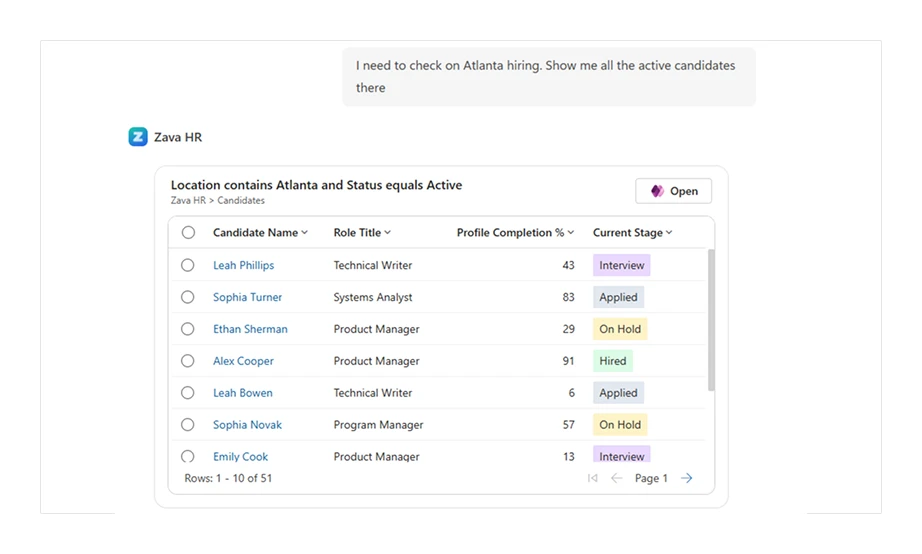

Every enterprise runs on its applications. Applications hold the business rules, the permissions, and the process knowledge that keeps work moving. We’re making the apps that you use daily dramatically more intelligent and productive. With these new updates, Microsoft Power Apps brings AI, Copilot, and agents directly into the apps and extends those apps’ intelligence out to the AI surfaces where work happens.
Here’s what’s new:
- Microsoft 365 Copilot is now generally available in model-driven apps and in public preview for canvas apps, bringing the full intelligence of Copilot into the flow of business processes.
- New app skills including data entry, exploration, visualization, and summarization are now generally available in Power Apps. App-based form and grid experiences in Copilot Chat will be generally available in July 2026, with support for custom UX entering preview.
- Agent feed with Power Apps MCP Server will be generally available on May 4, 2026, giving users a dedicated experience to supervise agent activity directly inside their business apps.
Each of these advancements aims at making AI useful where work actually happens. What sets this release apart is its interoperability: agents and Copilot are embedded directly within apps to boost productivity, while app capabilities are infused into agents to ground AI in real context and help make it more reliable and trustworthy.
Embedding Microsoft 365 Copilot directly within apps
The biggest productivity gains from AI come not from separate tools, but from embedding it inside the app where someone is already working, where the data model, business rules, and user context are all present.
Today, as users fill out a form, the app can convert emails or documents into structured fields automatically, with a review step before anything is saved. Natural-language search lets users simply ask, “show me open high-priority tickets this week,” instantly reshaping the view. AI-generated summaries distill long activity histories in seconds.
But this is just the starting point. With Microsoft 365 Copilot now generally available in model-driven apps, users gain something broader: the ability to ask questions and get answers grounded not just in the records on screen, but across the full breadth of business and productivity data through Microsoft Work IQ. The Copilot experience respects the same security, permissions, and business logic the app already enforces. Admins enable it at the tenant level. Makers configure it in a few clicks. The same app is now meaningfully more productive.
Bringing app skills to agents
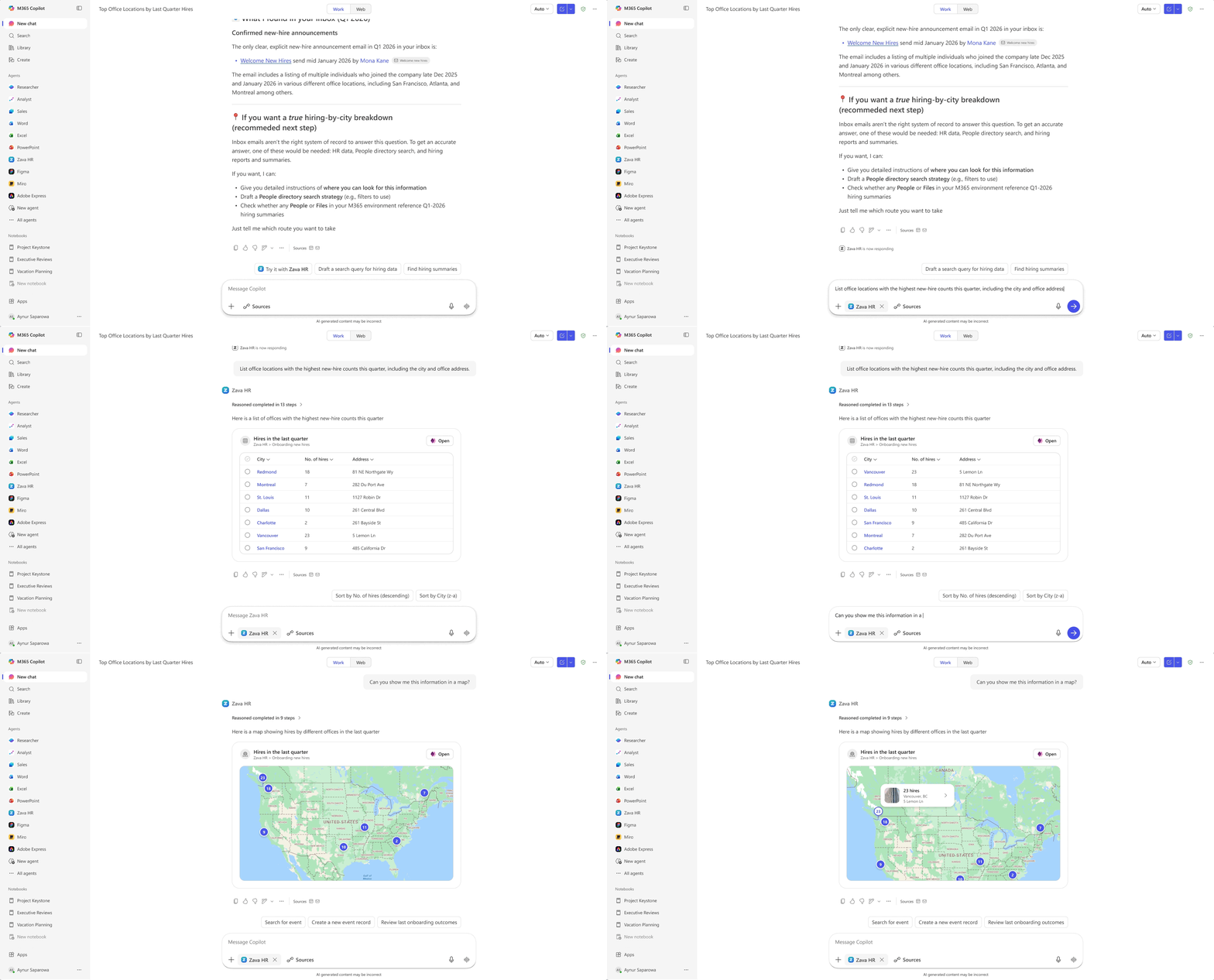
New app skills including data entry, exploration, visualization, and summarization are now generally available in Power Apps. But the value of a business application doesn’t stop at its own UI.
Using an app’s MCP server, these app skills—starting with structured form and grid views—can now be exposed as reusable tools for agents in public preview, with additional custom UX skills coming soon. This extends app productivity beyond the app itself to AI surfaces such as Copilot, custom agents, and automations.
This is where the two‑way relationship between apps and agents becomes tangible. In the previous section, AI and Copilot came into the app to help users work faster. Here, the app’s capabilities flow outward into agents and Copilot. For example, a recruiting app that has accumulated years of hiring policy can now power an agent that accesses the same records, enforces the same rules, and operates under the same controls. As organizations digitize more processes, their agents become more capable.
Human oversight where it matters most through the agent feed
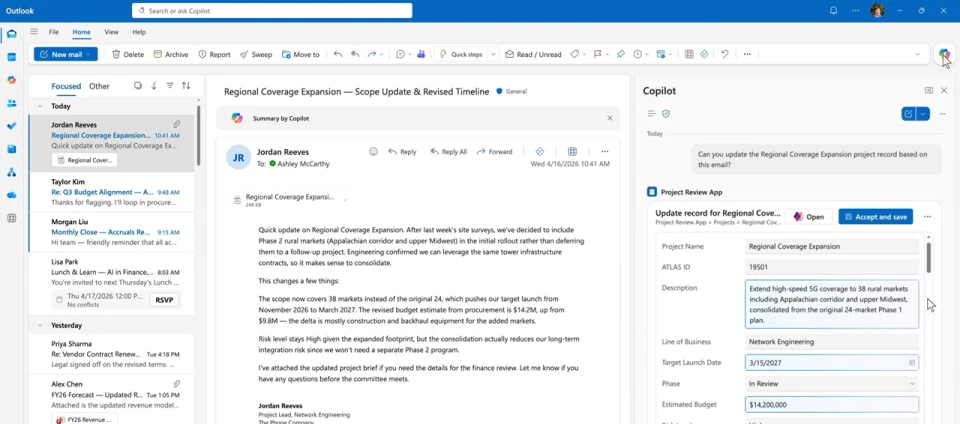
As agents execute more tasks, the question is how to keep humans in the loop at the right moments. The agent feed in model-driven apps, generally available in May 2026, answers that directly.
It gives business users a dedicated space to see, review, and guide agent activity as it happens and within the app, not in a separate monitoring tool. Makers control the approval threshold: low-risk actions complete quietly in the background; higher-impact actions like sending emails surface as explicit approvals. Side-by-side comparisons, deep links to records, and performance signals make oversight practical.
An insurance claims team, for example, uses an agent that extracts data from incoming emails and prepopulates case forms. Adjusters review and approve in the agent feed before anything enters the system. Humans oversee. Agents execute. Work gets done.
Turning AI from experimentation to execution
From embedding intelligence directly in apps, to extending app capabilities across AI surfaces like Copilot and custom agents, to empowering seamless human-AI collaboration through the agent feed, every component is connected. Together, this answers the question business and IT leaders are asking: how to bring AI into core business processes with real impact, without starting from scratch. This is what makes the shift from experimentation to execution real for the enterprise.
Watch the Business Applications Update event for product demos that show how apps, agents, and Microsoft 365 Copilot drive business transformation.