

Skip to main content Why Microsoft Security AI-powered cybersecurity Cloud security Data security & governance Identity & network access Privacy & risk management Security for AI Unified SecOps Zero Trust Microsoft Defender Microsoft Entra Microsoft Intune Microsoft Priva Microsoft Purview Microsoft Sentinel Microsoft Security Copilot Microsoft Entra ID (Azure Active Directory) Microsoft Entra Agent ID Microsoft Entra External ID Microsoft Entra ID Governance Microsoft Entra ID Protection Microsoft Entra Internet Access Microsoft Entra Private Access Microsoft Entra Permissions Management Microsoft Entra Verified ID Microsoft Entra Workload ID Microsoft Entra Domain Services Azure Key Vault Microsoft Sentinel Microsoft Defender for Cloud Microsoft Defender XDR Microsoft Defender for Endpoint Microsoft Defender for Office 365 Microsoft Defender for Identity Microsoft Defender for Cloud Apps Microsoft Security Exposure Management Microsoft Defender Vulnerability Management Microsoft Defender Threat Intelligence Microsoft Defender Suite for Business Premium Microsoft Defender for Cloud Microsoft Defender Cloud Security Posture Mgmt Microsoft Defender External Attack Surface Management Azure Firewall Azure Web App Firewall Azure DDoS Protection GitHub Advanced Security Microsoft Defender for Endpoint Microsoft Defender XDR Microsoft Defender for Business Microsoft Intune core capabilities Microsoft Defender for IoT Microsoft Defender Vulnerability Management Microsoft Intune Advanced Analytics Microsoft Intune Endpoint Privilege Management Microsoft Intune Enterprise Application Management Microsoft Intune Remote Help Microsoft Cloud PKI Microsoft Purview Communication Compliance Microsoft Purview Compliance Manager Microsoft Purview Data Lifecycle Management Microsoft Purview eDiscovery Microsoft Purview Audit Microsoft Priva Risk Management Microsoft Priva Subject Rights Requests Microsoft Purview Data Governance Microsoft Purview Suite for Business Premium Microsoft Purview data security capabilities Pricing Services Partners Cybersecurity awareness Customer stories Security 101 Product trials How we protect Microsoft Industry recognition Microsoft Security Insider Microsoft Digital Defense Report Security Response Center Microsoft Security Blog Microsoft Security Events Microsoft Tech Community Documentation Technical Content Library Training & certifications Compliance Program for Microsoft Cloud Microsoft Trust Center Security Engineering Portal Service Trust Portal Microsoft Secure Future Initiative Business Solutions Hub Contact Sales Start free trial Microsoft Security Azure Dynamics 365 Microsoft 365 Microsoft Teams Windows 365 Microsoft AI Azure Space Mixed reality Microsoft HoloLens Microsoft Viva Quantum computing Sustainability Education Automotive Financial services Government Healthcare Manufacturing Retail Find a partner Become a partner Partner Network Microsoft Marketplace Marketplace Rewards Software development companies Blog Microsoft Advertising Developer Center Documentation Events Licensing Microsoft Learn Microsoft Research View Sitemap

Digital transformation has made the traditional perimeter-based network defense obsolete. Your employees and partners expect to be able to collaborate and access organizational resources from anywhere, on virtually any device, without impacting their productivity. Customers expect personalized experiences that demonstrate you understand them and can adapt quickly to their evolving interests. Companies need to be able to move with agility, adapting quickly to changing market conditions and take advantage of new opportunities. Companies embracing this change are thriving, leaving those who don’t in their wake.

As organizations drive their digital transformation efforts, it quickly becomes clear that the approach to securing the enterprise needs to be adapted to the new reality. The security perimeter is no longer just around the on-premises network. It now extends to SaaS applications used for business critical workloads, hotel and coffee shop networks your employees are using to access corporate resources while traveling, unmanaged devices your partners and customers are using to collaborate and interact with, and IoT devices installed throughout your corporate network and inside customer locations. The traditional perimeter-based security model is no longer enough.

The traditional firewall (VPN security model) assumed you could establish a strong perimeter, and then trust that activities within that perimeter were “safe.” The problem is today’s digital estates typically consist of services and endpoints managed by public cloud providers, devices owned by employees, partners, and customers, and web-enabled smart devices that the traditional perimeter-based model was never built to protect. We’ve learned from both our own experience, and the customers we’ve supported in their own journeys, that this model is too cumbersome, too expensive, and too vulnerable to keep going.

We can’t assume there are “threat free” environments. As we digitally transform our companies, we need to transform our security model to one which assumes breach, and as a result, explicitly verifies activities and automatically enforces security controls using all available signal and employs the principle of least privilege access. This model is commonly referred to as “Zero Trust.”

Today, we’re publishing a new white paper to help you understand the core principles of Zero Trust along with a maturity model, which breaks down requirements across the six foundational elements, to help guide your digital transformation journey.
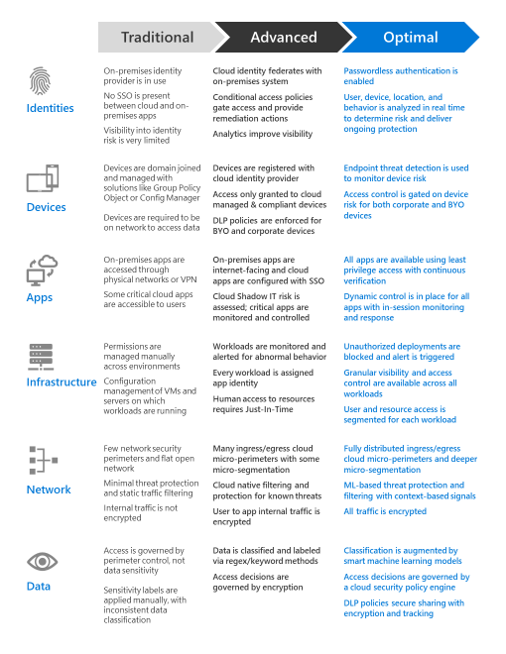
Microsoft Zero Trust Maturity Model

Download the Microsoft Zero Trust Maturity Model today!

Learn more about Zero Trust and Microsoft Security.

Also, bookmark the Security blog to keep up with our expert coverage on security matters. And follow us at @MSFTSecurity for the latest news and updates on cybersecurity.

To learn more about how you can protect your time and empower your team, check out the cybersecurity awareness page this month.

Related posts